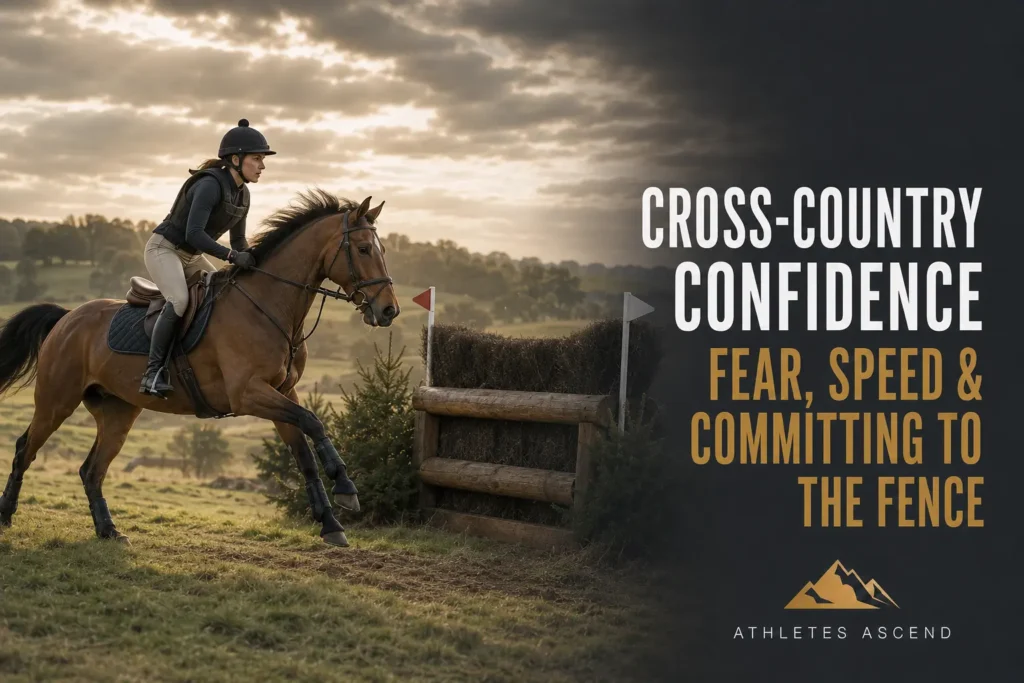
A rider may feel comfortable jumping in an arena but experience something very different when riding across country.
The fences are fixed, the terrain changes and the horse is travelling at greater speed. There may be water, ditches, drops, banks and combinations that leave little time for hesitation.
The rider may have the technical ability, yet shorten their stride, interfere with the rhythm or imagine what could go wrong.
Cross-country confidence is not about becoming fearless. It is about respecting genuine risk while remaining able to make clear decisions and use the skills developed through training.
Call +44 07807 540142 or email me
Book Your Session
Ask a Question
Why Can Cross-Country Confidence Change?
Confidence may change after a fall, stop, run-out or uncomfortable jump. It can also be affected by witnessing another rider’s accident or progressing to a level where the questions feel less forgiving.
Common concerns include:
- Jumping fixed fences.
- Riding at speed over uneven ground.
- Approaching water, ditches or drops.
- Losing control in open spaces.
- Worrying that the horse will stop or run out.
- Seeing a stride at an unfamiliar fence.
- Riding combinations that require quick decisions.
- Returning after injury or time away.
- Feeling responsible for the horse’s safety.
One obstacle may become the focus of fear, or the rider may lose trust in the entire phase.
Fear of the Known and the Unknown
Cross-country fear may involve the unknown: a new venue, unfamiliar question or first attempt at a higher level.
It may also involve something known. The rider remembers exactly what happened at a similar fence and expects it to happen again.
The United States Eventing Association’s guidance on overcoming cross-country fear distinguishes between fear of the unknown and fear arising from previous or imagined experiences. It emphasises experienced coaching, suitable progression and an appropriate horse.
Positive thinking cannot replace technical preparation. Equally, technical practice alone may not address an established fear response.
When Anticipation Changes the Approach
As the rider approaches the fence, attention may move away from rhythm, line and communication with the horse.
Instead, the rider begins monitoring danger:
What if the horse stops?
What if I get this wrong?
I cannot commit at this speed.
These thoughts may alter breathing, balance, contact and timing. The rider could become restrictive, change the pace unnecessarily or send conflicting signals.
If the fence then becomes awkward, the experience appears to prove that the fear was justified. This can develop into a cycle of anticipation, tension, interference and reduced trust.
It is one example of how overthinking in sport affects physical performance.
Confidence After a Fall or Stop
A rider may feel pressure to return quickly, although physical recovery and psychological readiness do not always happen simultaneously.
The page on horse-riding confidence after a fall explores this wider return process.
Rebuilding does not mean reproducing the frightening situation immediately. An experienced cross-country instructor can assess the rider, horse and technical circumstances before designing an appropriate progression.
The goal is to create reliable evidence rather than test whether fear has vanished.
Commitment Is Not Recklessness
Cross-country riding requires commitment, but that word can be misunderstood.
Commitment does not mean ignoring fear, charging at a fence or continuing when the situation is unsuitable. It means making an appropriate decision and riding that decision clearly.
Hesitation can reduce clarity between horse and rider. However, circling, withdrawing or seeking further instruction can sometimes be responsible.
Confidence includes trusting yourself to continue when appropriate and to stop when necessary.
Responding After an Error
One awkward fence can affect the remainder of the round if the rider continues analysing it. Learning to recover after mistakes means checking what is necessary and returning attention to the next question. It prevents one moment from controlling everything that follows.
How Sports Mindset Coaching May Help
Mindset coaching may help when anticipation, memories and conscious interference prevent the rider from accessing existing skills.
Work may include:
- Identifying obstacles and situations that trigger fear.
- Separating technical concerns from learned anticipation.
- Reducing the emotional significance of a previous incident.
- Developing clear attentional cues.
- Preparing for competition and unfamiliar courses.
- Responding constructively after an error.
- Strengthening trust in training.
- Building sports confidence through progressive evidence.
Inner Voice Awareness™ may help when the rider gives themselves several conflicting instructions during the approach.
Flow State Activation™ may support presence, responsiveness and trust. Where appropriate, NLP and hypnotherapy for sports performance may also form part of an individual approach.
None of these replaces qualified technical coaching, veterinary assessment, safe course design, appropriate equipment or medical rehabilitation.
Coach’s Insight
The rider often asks:
How do I make myself stop feeling afraid?
A more useful question may be:
What would allow me to make a clear and appropriate decision at this fence?
Fear does not always need to disappear before clarity can return.
Frequently Asked Questions
Is cross-country fear normal?
Yes. Cross-country contains genuine risk and uncertainty. The important question is whether fear is providing useful information or preventing the rider from using appropriate skills.
Should I repeatedly jump the fence that frightens me?
Not without suitable assessment. Repetition should be technically appropriate, safely graded and guided by an experienced instructor.
Can mindset coaching replace cross-country instruction?
No. It may support confidence, attention and responses to pressure. Technical cross-country instruction remains essential.
Riding Cross-Country With Greater Trust
Cross-country requires courage balanced with judgement.
The wider process may connect with equestrian performance psychology, showjumping confidence and dressage performance psychology.
The aim is to respect risk while remaining present, communicating clearly and committing appropriately to the situation ahead.
Cross-Country Confidence Coaching in Reading and Online
Matthew Exell provides sports mindset coaching for cross-country riders in Reading, Berkshire, as well as online across the UK and internationally. Support may be useful when speed, solid fences, drops, water or a previous difficult experience has affected the rider’s confidence. Sessions can explore whether fear is providing useful information or creating a learned expectation that interferes with decisions, commitment and communication with the horse. The aim is not to remove sensible caution or encourage somebody to attempt a fence beyond their current ability. It is to work alongside appropriate technical instruction, rebuild confidence progressively and help the rider trust their training without overlooking genuine safety considerations.
Call +44 07807 540142 or email me