A baseball player may have made the same throw thousands of times.
Then something changes.
A pitcher who could locate the strike zone begins spiking the ball or throwing wildly. A catcher struggles to return the ball to the mound. An infielder can make a difficult play but cannot complete the routine throw to first base.
The player knows how to throw, and the movement may still appear normally in practice. Yet under particular conditions, the release feels delayed, forced or no longer under voluntary control.
These experiences are commonly called the throwing yips or pitching yips.
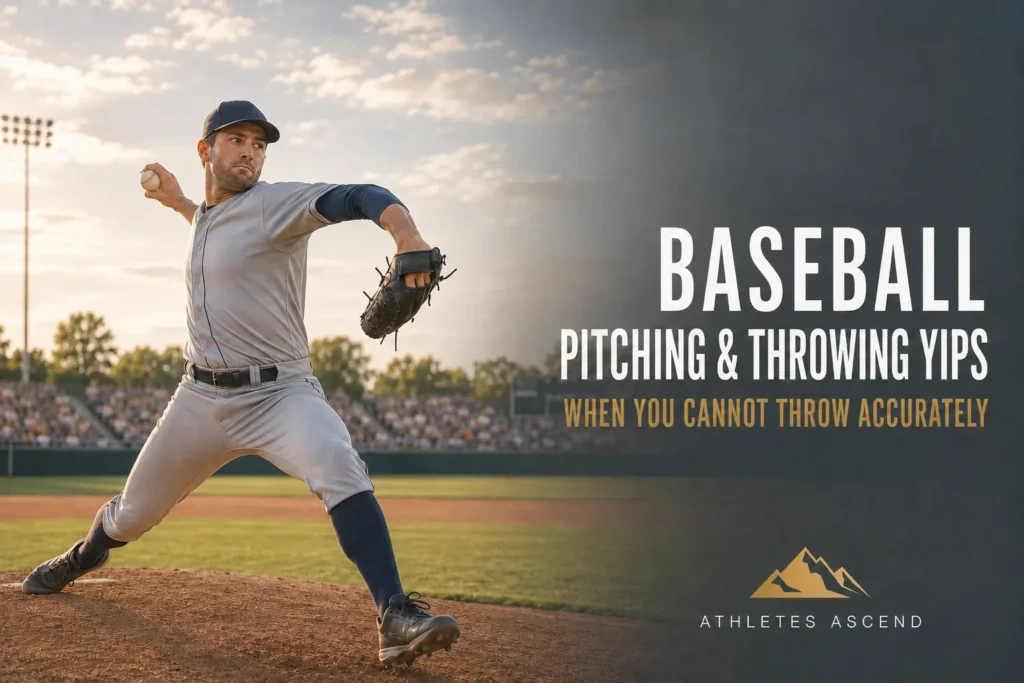
What Are the Throwing Yips in Baseball?
The throwing yips describe a sudden or persistent disruption to a previously learned throwing action.
A player may experience:
- Wild pitches or an unexplained loss of command.
- Freezing before the arm comes forward.
- Spiking, sailing or double-clutching a routine throw.
- Throwing normally over longer distances but struggling close to the target.
- Catching comfortably but hesitating when returning the ball.
- Accurate bullpen or warm-up throws followed by loss of control in games.
- Tightness, jerking or needing to lob a previously automatic throw.
- Fear that teammates, coaches or scouts will notice.
Pitchers are strongly associated with the problem, but catchers, infielders and other position players can also be affected. Throwing yips therefore captures more than pitching alone.
Why an Easy Throw Can Become the Hardest
One of the most confusing features is that a player may complete a demanding throw and then struggle from a short distance.
The difficult play invites reaction. There is little time to supervise it. The easy throw creates time to think:
Do not sail it. Release it properly. Everyone is watching. Just make the simple throw.
The player moves from seeing the target towards consciously controlling the wrist, elbow, shoulder and release. One coordinated action becomes several instructions.
This is where overthinking in sport and performance anxiety can interfere with automatic performance.
Is It Mental, Technical, Physical or Neurological?
Not every loss of accuracy is the yips, and not every case is purely psychological.
Fatigue, pain, injury, changes in mechanics, workload or throwing volume may affect control. Nerve and shoulder problems require appropriate medical assessment. A qualified baseball or pitching coach should also assess the action.
Research has documented involuntary contractions, jerks, tremors and freezing. A 2024 study of 285 youth players reported yips symptoms in 10.2% of its sample, with pitchers affected more often and short throws particularly troublesome. This does not establish population-wide prevalence, but the experience is measurable rather than imaginary. Read the youth baseball study.
There are also documented cases of task-specific dystonia associated with throwing. Persistent spasms or abnormal contractions may justify medical assessment. Mindset coaching cannot diagnose or treat dystonia.
At the same time, anticipation, embarrassment, fear and excessive control can clearly maintain some throwing problems. Physical and psychological influences may overlap.
The Baseball Yips Cycle
The cycle often develops like this:
- A throw goes badly or produces a frightening loss of control.
- The player assigns significance to it.
- The next similar throw triggers anticipation.
- Muscles tighten and attention turns inward.
- The player guides, forces or delays the release.
- The throw confirms that something is wrong.
- Every repetition becomes another test.
Appropriate technical work matters, but repeatedly analysing video and making emergency adjustments can increase uncertainty. This damages sports confidence beyond the original throw.
Famous Players Who Experienced the Yips
Rick Ankiel was one of baseball’s leading young pitchers before losing control during the 2000 postseason. After years attempting to recover his pitching, he rebuilt his career as an outfielder and returned to Major League Baseball in 2007. His story shows both the problem’s severity and the possibility of another route forward.
Second baseman Chuck Knoblauch struggled with routine throws to first and eventually moved to the outfield. Catcher Mackey Sasser hesitated before returning the ball to the pitcher. Steve Sax later regained his reliability, while Steve Blass lost command so dramatically that his name became associated with unexplained loss of throwing ability.
Major League Baseball’s account of players who battled the yips demonstrates that elite ability offers no immunity.
The Emotional Cost for Players and Parents
Players may avoid warm-ups because even playing catch feels exposing. Some hide their discomfort or consider leaving baseball. A young player can feel responsible for losing games and ashamed that a basic action has become unreliable.
Parents may respond by booking more pitching lessons or telling the player to relax. Both are understandable, but more repetitions can intensify the pattern when every throw becomes an examination.
The athlete is usually not lazy or unwilling. They desperately want to throw while experiencing a response that interrupts the action. Shame strengthens fear of failure rather than resolving it.
Rebuilding the Throw Without Constantly Testing It
Practice may need to be redesigned with a qualified baseball coach.
Progression might include:
- Comfortable throwing without an accuracy test.
- Changing distance, target size or intensity gradually.
- Short, purposeful throwing blocks.
- Rhythm-based tasks rather than constant mechanical inspection.
- Later reintroducing batters, runners, teammates and game consequences.
The objective is to build credible evidence while the player learns to trust their training again.
Attention, Routine and Self-Talk
A simple routine can organise breathing, target selection and commitment without becoming a ritual that must feel perfect.
Mindset coaching can simplify the athlete’s cue. Effective concentration in sport is selective; a player cannot consciously manage every joint involved in a high-speed throw.
Developing Inner Voice Awareness™ may help when the final seconds contain conflicting commands such as “throw freely” and “whatever happens, do not miss”.
Can NLP or Hypnotherapy Help Baseball Yips?
NLP or hypnotherapy may be considered when an athlete replays a humiliating throw or has connected one situation with danger and embarrassment.
Work may involve changing the trigger’s emotional meaning, rehearsing a calmer response and reducing catastrophic predictions. Players with aphantasia can rehearse using rhythm, sound, physical sensation and verbal intention.
There is not strong evidence that NLP or hypnotherapy provides a universal cure. These approaches should complement coaching and healthcare, never replace them or pressure an athlete through pain. The boundaries are explained on my page about NLP and hypnotherapy in sports performance.
How Sports Mindset Coaching May Help
Mindset work may include:
- Mapping exactly when and where control changes.
- Identifying fear, shame and conscious interference.
- Changing the response to one wild or hesitant throw.
- Developing a flexible pre-throw routine.
- Rebuilding confidence through progressive evidence.
- Preparing for tryouts, game pressure and being watched.
- Helping the player recover after mistakes.
- Coordinating psychological work with the athlete’s technical coach.
Online support makes this relevant beyond Britain. Baseball is played extensively in the United States, Canada, Mexico, Venezuela, the Caribbean and parts of Europe. The language differs, but the conflict is familiar.
Coach’s Insight
The player usually asks:
How can I guarantee that the next throw goes where I want it?
A more useful question may be:
What would allow me to see the target, commit and throw without supervising the movement?
Confidence means being able to act without requiring certainty first.
requently Asked Questions
Can pitchers suddenly develop the yips?
Yes. They may appear after a wild pitch, injury, pressured game or increasing self-monitoring. Sometimes there is no obvious trigger.
Why can I throw in practice but not in games?
Games introduce judgement and consequence. Attention, tension and timing may change even when the ability remains available.
Why can I throw far but not make a short throw?
Long throws may encourage commitment. Short throws provide more opportunity to guide the ball and control the release.
Should I rebuild my mechanics?
Not without assessment. Technical changes may be appropriate, but repeatedly rebuilding functional mechanics can deepen uncertainty.
Are baseball yips neurological?
Some cases may involve task-specific dystonia or physical influences. Others appear connected with anxiety and conscious interference. Assessment matters.
Can mindset coaching guarantee recovery?
No. It may help when fear, attention and learned anticipation maintain the problem. Physical health and technical readiness remain essential.
Throwing Freely Again
Baseball throwing yips can make a skilled player feel separated from their own arm.
Progress begins by establishing what is technical, physical, psychological or neurological. From there, practice and support can become specific rather than driven by panic.
The aim is not to force the arm into obedience. It is to create the conditions in which the player can commit to the target, release the throw and gradually experience the movement as their own again.