One of the most common pieces of advice in sport is:
“Visualise success.”
Imagine the perfect shot.
Picture yourself winning.
See yourself crossing the finish line.
But what happens if you can’t create mental images?
For athletes with aphantasia, visualisation may simply not be possible.
That doesn’t mean you can’t become an outstanding athlete.
It simply means your mind works differently.
Many athletes with aphantasia perform at an exceptionally high level by using different ways of thinking, preparing and learning.
Success in sport is not dependent on seeing pictures in your mind.
Call +44 07807 540142 or email me
Book Your Session
Ask a Question
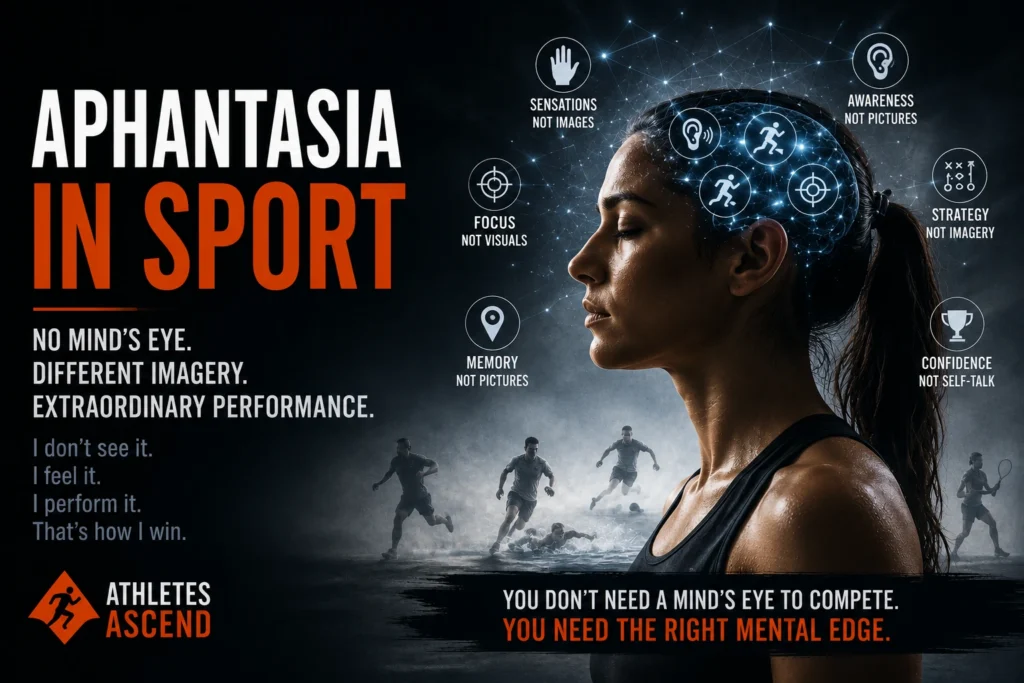
What Is Aphantasia?
Aphantasia is the inability, or greatly reduced ability, to create voluntary mental images.
People with aphantasia often cannot deliberately picture:
- Faces.
- Places.
- Memories.
- Objects.
- Sporting movements.
However, they can still think, remember, solve problems, learn skills and perform at a very high level.
Many people with aphantasia don’t realise their experience is different until adulthood.
Can Athletes With Aphantasia Perform at a High Level?
Absolutely.
Aphantasia does not prevent sporting success.
Athletes with aphantasia develop other ways of processing information, including:
- Feeling movement.
- Remembering sequences.
- Understanding technique.
- Using internal dialogue.
- Responding to rhythm and timing.
- Focusing on physical sensations.
Elite performance depends upon many psychological and physical skills—not simply visual imagery.
When Traditional Sports Psychology Doesn’t Fit
Many mental training programmes assume every athlete can visualise.
This can leave athletes with aphantasia feeling frustrated or believing they’re doing something wrong.
In reality, nothing is wrong.
The strategy simply doesn’t match how your mind naturally works.
Effective coaching should always adapt to the individual rather than expecting every athlete to think in exactly the same way. Anendophasia can also be helped as can many other psychological issues,
Alternative Mental Training Strategies
Athletes with aphantasia often benefit from approaches such as:
- Constructive self-talk.
- Emotional rehearsal.
- Physical rehearsal.
- Process-based thinking.
- Movement awareness.
- Breathing techniques.
- Performance routines.
- Flow-based preparation.
These methods can be every bit as effective as visual imagery when matched to the individual athlete.
A Different Way of Thinking
Aphantasia doesn’t mean an absence of imagination.
It simply means imagination may operate differently.
Some athletes think primarily through:
- Words.
- Feelings.
- Concepts.
- Movement.
- Logic.
- Sound.
Understanding your own thinking style often becomes one of the biggest advantages you can develop. Using NLP will help.
My Experience With Aphantasia
At Athletes Ascend, this isn’t simply a topic of professional interest.
I also have aphantasia.
That personal experience has shaped the way I coach.
Rather than assuming every athlete learns through visualisation, I help athletes discover the strategies that genuinely suit the way their own minds work.
Because there is no single “correct” way to think.
Aphantasia Insight
You don’t need to picture success to achieve it.
You need an approach that matches the way your mind naturally works.
Coach’s Observation
I’ve worked with athletes who believed they were failing because visualisation never seemed to work for them.
The problem wasn’t the athlete.
The problem was assuming every mind works the same way.
When coaching adapts to the individual, confidence often grows remarkably quickly.
How Sports Mindset Coaching Can Help
Athletes with aphantasia often benefit from coaching that moves beyond traditional visualisation.
At Athletes Ascend, we explore approaches based on self-talk, emotional awareness, reliving anxiety, movement, identity, habits, confidence and practical mental strategies that fit the way you naturally think.
The objective isn’t to force visualisation.
It’s to help you perform at your best using methods that genuinely work for you. Learn how to use your inner voice with awareness and develop flow state on demand,
Frequently Asked Questions
Can athletes with aphantasia succeed in sport?
Absolutely. Aphantasia does not prevent high-level sporting performance. Many athletes naturally rely on other forms of thinking and mental preparation.
Is visualisation essential for success?
No. Visualisation can be helpful for some athletes, but it is only one of many mental training methods available.
How do athletes with aphantasia prepare mentally?
Preparation may involve self-talk, movement awareness, routines, emotional rehearsal, breathing techniques and process-focused thinking rather than visual imagery.
Does aphantasia affect learning skills?
Not necessarily. People with aphantasia often learn extremely effectively using methods that suit their own cognitive style.
Can sports mindset coaching help athletes with aphantasia?
Yes. Coaching can be adapted to the individual so that mental training reflects how the athlete naturally thinks rather than relying on visualisation alone.
How I Work With Athletes
I combine practical sports mindset coaching with NLP, hypnotherapy where appropriate, and performance-psychology principles. The approach depends on the athlete, the sport and what is maintaining the problem. It complements technical coaching, medical care and rehabilitation rather than replacing them.
Your Mind Doesn’t Need Pictures to Perform
The best athletes don’t all think the same way.
Neither should they.
Understanding how your own mind works is often one of the greatest competitive advantages you can develop.
At Athletes Ascend, we help athletes with aphantasia build confidence, develop effective mental strategies, a strengthened mind and perform at their highest level—without relying on visualisation.
Call +44 07807 540142 or email me