You can strike penalties perfectly in training.
Then the referee points to the spot, everyone watches and the goal suddenly looks smaller.
Your breathing changes. Your legs feel heavy. You reconsider the corner, worry about embarrassment or imagine the goalkeeper saving it before you have even placed the ball.
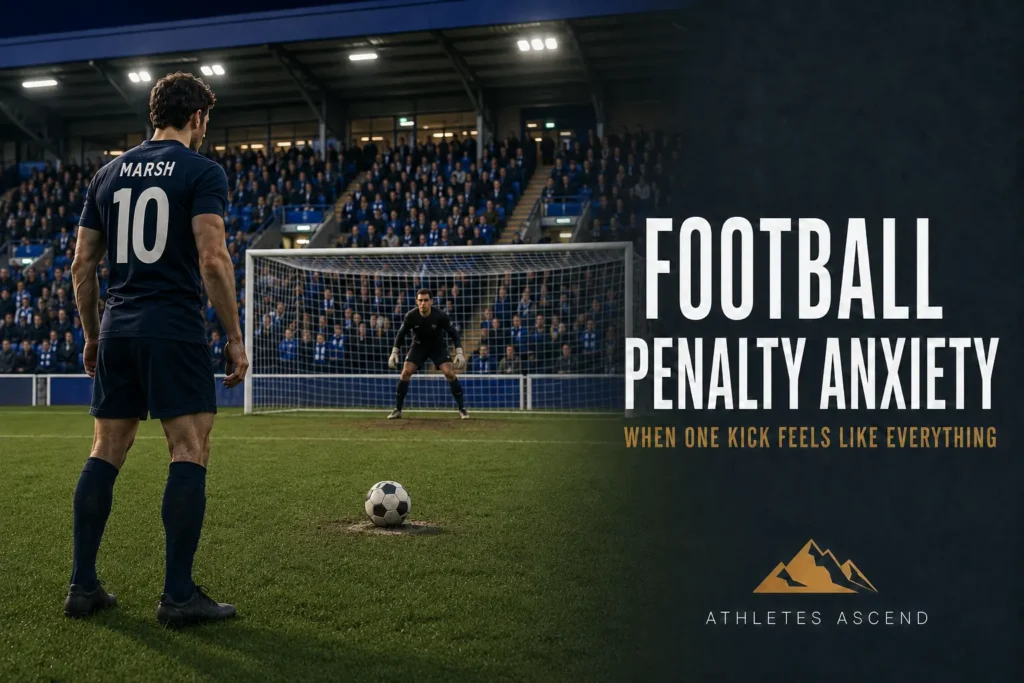
This is football penalty anxiety. It can affect professionals, academy players and amateurs because a penalty is an exposed moment with time to think and nowhere to hide.
What Does Penalty Anxiety Feel Like?
Players may experience:
- A racing heart or shaky legs.
- Changing their chosen corner during the run-up.
- Looking repeatedly at the goalkeeper.
- Rushing after the referee’s whistle.
- Striking more safely rather than decisively.
- Thinking, “Do not miss” instead of focusing on the kick.
- Avoiding responsibility in a shootout.
- Replaying a previous miss as they approach the ball.
- Scoring in training but freezing in matches.
- Losing confidence after one important penalty.
Searches such as “how to stop being nervous taking penalties”, “fear of missing a penalty”, “how to score penalties under pressure” and “penalty shootout anxiety” all point towards the same difficulty: the player knows how to kick a ball, but pressure changes access to that ability.
Why Penalties Create So Much Pressure
A penalty appears easy because the taker has a considerable advantage. That expectation can make missing feel less acceptable.
In open play, players react. Before a penalty, they wait, walk to the spot, place the ball and stand alone. That space allows overthinking in sport to grow.
The player may picture the score, teammates, supporters, social media or the journey home. During a shootout, the kick may seem to carry the hopes of an entire club or country. Fear shifts attention away from the intended target and towards the consequences of failure.
This is where performance anxiety in sport can alter breathing, muscle tension, timing and decision-making.
What Research Tells Us About Choking
Professor Geir Jordet has studied hundreds of major shootout kicks. His work connects unsuccessful penalties with ego threat, emotional distress, avoidance and loss of self-regulation.
Research suggests anxious takers can become drawn towards the goalkeeper. The perceived threat captures the eyes, and the shot may travel closer to the person the player is trying to avoid.
A high-pressure penalty study from the University of Huddersfield found increased cognitive anxiety and breathing rates, less consistent shot placement and a shift from useful focus towards worry and distraction.
The practical message is important. Penalty anxiety is not proof of weakness. Pressure creates measurable changes—but those changes can be prepared for.
Famous Misses—and What Happened Afterwards
Roberto Baggio called his 1994 World Cup final miss the worst moment of his career and said it affected him for years. Yet he scored from the spot at the 1998 World Cup.
Stuart Pearce missed in England’s 1990 World Cup semi-final defeat. He used the disappointment as motivation and scored in the Euro 1996 shootout against Spain. Recovery did not require pretending the original miss meant nothing.
Bukayo Saka missed the decisive penalty in the Euro 2020 final and received appalling racial abuse. Against Switzerland at Euro 2024, he volunteered again and scored, explaining that he had used the experience to become stronger.
Cristiano Ronaldo was in tears after Jan Oblak saved his extra-time penalty against Slovenia at Euro 2024. Minutes later, he scored Portugal’s first shootout kick. His response demonstrated an ability to reset and recommit.
These stories connect with recovering from mistakes. A miss can be painful without becoming a permanent identity.
What Did Matt Le Tissier Do Differently?
Matt Le Tissier scored 47 of his 48 penalties for Southampton. His record did not mean he possessed a magical absence of nerves.
Le Tissier practised, struck the ball cleanly and made the goalkeeper’s task difficult. Accounts emphasise confidence in his technique and a decisive finish.
His example matters because confidence does not have to mean excitement or bravado. It can mean reducing the decision to a familiar process: place the ball, choose the action and execute it fully.
Other takers use different strategies. Ivan Toney has discussed working with sports psychologist Michael Caulfield on emotional control. İlkay Gündoğan emphasises practising the routine, breathing and becoming calm.
There is no single personality required to take a good penalty. The useful question is whether the player has a repeatable process they trust.
The Pre-Penalty Routine
A routine gives attention somewhere useful to go. It might organise:
- The decision before placing the ball.
- One or two settling breaths.
- A consistent number of steps.
- One external target or performance cue.
- A deliberate response to the whistle.
- Commitment without a last-second negotiation.
The routine should remain flexible. If the goalkeeper delays the kick, moves the ball or creates confrontation, the taker may need to step away and restart rather than allowing the goalkeeper to dictate the rhythm.
This supports focus in sport and trusting your training. It does not guarantee a goal; it increases the chance that pressure will not completely rewrite the action.
Practising Pressure, Not Just Penalties
Taking fifty casual penalties after training develops technique, but it does not fully prepare a player for one decisive kick.
Pressure cannot be reproduced exactly, but training can include consequence, competition, waiting, distraction and one-shot opportunities. Intensity should be progressive rather than humiliating.
Players can also rehearse what happens after a disruption: replacing the ball, responding to delay, recovering from a poor previous kick and taking another penalty after missing. This creates evidence for rebuilding sports confidence.
Can NLP or Hypnotherapy Help?
Some players know what to do but automatically replay an old miss, imagine ridicule or experience a surge of tension at the spot.
NLP or hypnotherapy may help explore the meaning attached to the penalty, change unhelpful internal language, mentally rehearse pressure and reduce a learned emotional response. A player with aphantasia can rehearse through sound, movement, emotion and bodily sensation rather than pictures.
There is not strong public evidence that the famous players above used NLP or hypnosis for their penalties, so it would be irresponsible to imply that they did. These approaches should complement technical coaching and realistic pressure practice, not replace them or promise a perfect conversion rate. You can read more about NLP and hypnotherapy for sports performance.
How Sports Mindset Coaching May Help
Mindset work may include:
- Mapping thoughts during the wait, walk and run-up.
- Separating a missed kick from personal worth.
- Developing a short, adaptable routine.
- Directing attention away from threat and towards intention.
- Using breathing without making calmness compulsory.
- Preparing for goalkeeper gamesmanship and delays.
- Rehearsing shootouts and decisive match situations.
- Developing Inner Voice Awareness™ when several instructions compete.
The aim is not to remove every nerve. Trying to feel completely calm can become another test. Better emotional control in sport means recognising the state, returning to the process and acting with commitment.
Coach’s Insight
The anxious player asks:
How can I make sure I do not miss?
No player can have that certainty.
A more useful question is:
How can I give this penalty my full commitment, even while the outcome remains uncertain?
That distinction moves the player from avoiding failure towards performing the kick.
Frequently Asked Questions
Why do I score penalties in training but miss in matches?
Matches add consequence, judgement, delay and physical arousal. Training should develop both technique and familiarity with pressure.
Is looking at the goalkeeper a mistake?
Not automatically. Some skilled takers use goalkeeper-dependent strategies. The problem occurs when anxiety pulls attention towards the goalkeeper without a deliberate plan.
Can confidence return after an important miss?
Yes. Pearce, Saka and Ronaldo all took significant penalties again. Confidence is rebuilt through preparation, appropriate attempts and a healthier response to outcomes.
Can mindset coaching guarantee that I score?
No. It may improve attention, emotional regulation and commitment, but technique, goalkeeper performance and chance still matter.
Taking Responsibility Without Carrying the Whole Result
A penalty taker accepts responsibility for the process, not complete control over the outcome.
The player can prepare the technique, choose the strategy, regulate attention and commit to the strike. They cannot guarantee where the goalkeeper dives or whether every well-hit shot goes in.
Penalty confidence is not the belief that missing is impossible. It is the ability to walk forward, follow a trusted process and take the kick without allowing fear of failure to make the decision.