Every athlete questions themselves from time to time.
After a mistake, a poor performance or a difficult period of training, it’s perfectly normal to wonder whether you’re good enough. The problem isn’t having occasional doubts. The problem begins when those doubts become louder than your ability.
Self-doubt can quietly undermine confidence, increase anxiety and lead athletes to hesitate at exactly the moments they need to commit.
Ironically, self-doubt often affects athletes who care deeply about their performance. They set high standards, work incredibly hard and want to improve. Yet instead of recognising their progress, they become focused on everything they believe they’re doing wrong.
The objective isn’t to eliminate every doubt. It’s to stop doubt from becoming the voice that controls your performance.
Call +44 07807 540142 or email me
Book Your Session
Ask a Question
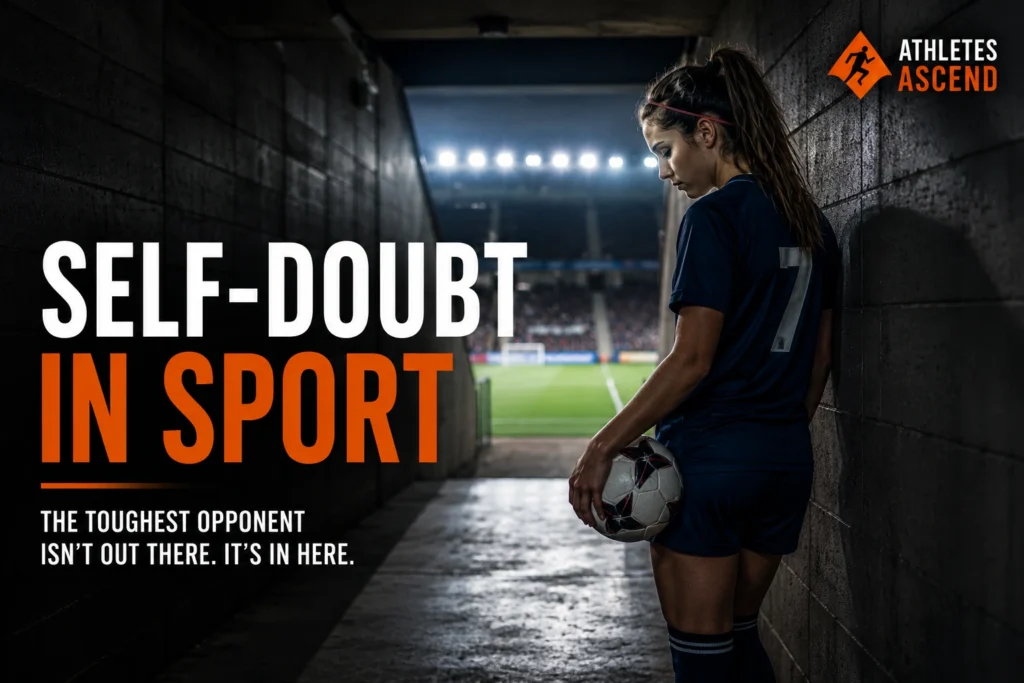
What Is Self-Doubt?
Self-doubt is uncertainty about your own ability, judgement or potential.
It often sounds like an internal conversation:
- “What if I’m not good enough?”
- “What if everyone else is better than me?”
- “What if I let everyone down?”
- “Maybe I don’t deserve to be here.”
- “I always mess things up.”
These thoughts can appear before competition, during performance or after mistakes.
Having them doesn’t mean they’re true.
Why Do Athletes Experience Self-Doubt?
Self-doubt can develop for many different reasons.
Common causes include:
- Poor performances.
- Repeated mistakes.
- Imposter syndrome
- Returning after injury.
- Comparing yourself with others.
- Negative coaching experiences.
- Perfectionism.
- Fear of failure.
- Fear of success.
- Performance anxiety.
- Unrealistic expectations.
- Confidence issues.
Sometimes self-doubt develops gradually.
Other times it appears suddenly after one significant setback.
How Self-Doubt Affects Performance
When athletes stop trusting themselves, they often begin performing differently.
They may:
- Hesitate before making decisions.
- Overthink simple skills.
- Become overly cautious.
- Lose focus.
- Avoid taking positive risks.
- React emotionally to mistakes.
- Lose confidence during competition.
- Play not to lose instead of playing to succeed.
The physical ability often remains unchanged.
The athlete simply stops trusting it.
Self-Doubt Isn’t the Same as Reality
One of the biggest mistakes athletes make is believing every thought that enters their mind.
Thoughts are not facts.
A doubtful thought doesn’t prove you lack ability.
It simply reflects what your mind is producing at that moment.
The athletes who perform consistently learn to notice self-doubt without automatically believing it.
They acknowledge it, then return their attention to the next action.
Confidence Is Built Through Evidence
Lasting confidence doesn’t come from repeating positive affirmations.
It grows through evidence.
Every training session completed.
Every challenge overcome.
Every setback recovered from.
Every skill developed.
The more evidence you collect, the easier it becomes to trust yourself when pressure arrives.
Confidence isn’t built by being perfect.
It’s built by repeatedly proving to yourself that you can cope.
Trust Your Preparation
Elite athletes rarely feel completely certain before every competition.
What they trust is their preparation.
They know they’ve done the work.
They understand that no amount of worrying will improve performance.
So instead of trying to remove every doubt, they commit fully to the task in front of them.
Action often weakens self-doubt far more effectively than endless analysis.
Self-Doubt Insight
Confidence isn’t the absence of doubt.
It’s trusting yourself enough to move forward anyway.
Coach’s Observation
Self-doubt often asks one question over and over again:
“What if I fail?”
Successful athletes gradually learn to replace it with a different question:
“What if I’m more capable than I currently believe?”
Sometimes changing the question changes everything.
How Sports Mindset Coaching Can Help
Self-doubt isn’t something you simply “snap out of.”
It usually develops over time, which means rebuilding confidence also takes a structured approach.
Sports mindset coaching helps athletes strengthen self-belief, improve emotional regulation, reduce overthinking, rebuilding confidence, develop healthier self-talk and build confidence based on preparation and experience rather than temporary emotions.
The aim isn’t to become fearless.
It’s to trust yourself enough to perform despite uncertainty.
Using Inner Voice Awareness™ and Flow State Activation™ will help you overcome any self-doubs.
Frequently Asked Questions
Is self-doubt normal in sport?
Yes. Almost every athlete experiences periods of self-doubt, particularly after setbacks, injuries or important competitions.
Can confident athletes still experience self-doubt?
Absolutely. Even elite athletes occasionally question themselves. The difference is that they don’t allow those doubts to control their actions.
Is self-doubt the same as low confidence?
They’re closely related, but not identical. Self-doubt refers to questioning your ability, while confidence is your overall belief that you can perform successfully.
Can self-doubt cause overthinking?
Yes. Athletes who doubt themselves often analyse every decision, increasing hesitation and making natural performance more difficult.
Can sports mindset coaching help with self-doubt?
Yes. Athletes can develop stronger self-belief, healthier thinking patterns and greater trust in their preparation, allowing them to compete with more confidence and consistency.
How I Work With Athletes
I combine practical sports mindset coaching with NLP, hypnotherapy where appropriate, and performance-psychology principles. The approach depends on the athlete, the sport and what is maintaining the problem. It complements technical coaching, medical care and rehabilitation rather than replacing them.
Trust Yourself More Than Your Doubts
Every athlete hears an inner voice.
The important question isn’t whether doubt appears.
It’s whether you choose to follow it.
At Athletes Ascend, we help athletes build genuine self-belief, develop healthier confidence and learn to trust their preparation, their abilities and themselves when performance matters most.
Call +44 07807 540142 or email me