A showjumper may know they can clear the fence.
They have jumped it before and their instructor believes they are capable. Yet as they turn towards the fence, their confidence disappears.
The rider may shorten the reins, grip with their knees, hold their breath or interfere with the rhythm. Some hesitate, pull out or circle repeatedly.
Showjumping confidence is not simply about bravery. It involves trust in your preparation, decisions, horse and ability to respond.
Call +44 07807 540142 or email me
Book Your Session
Ask a Question
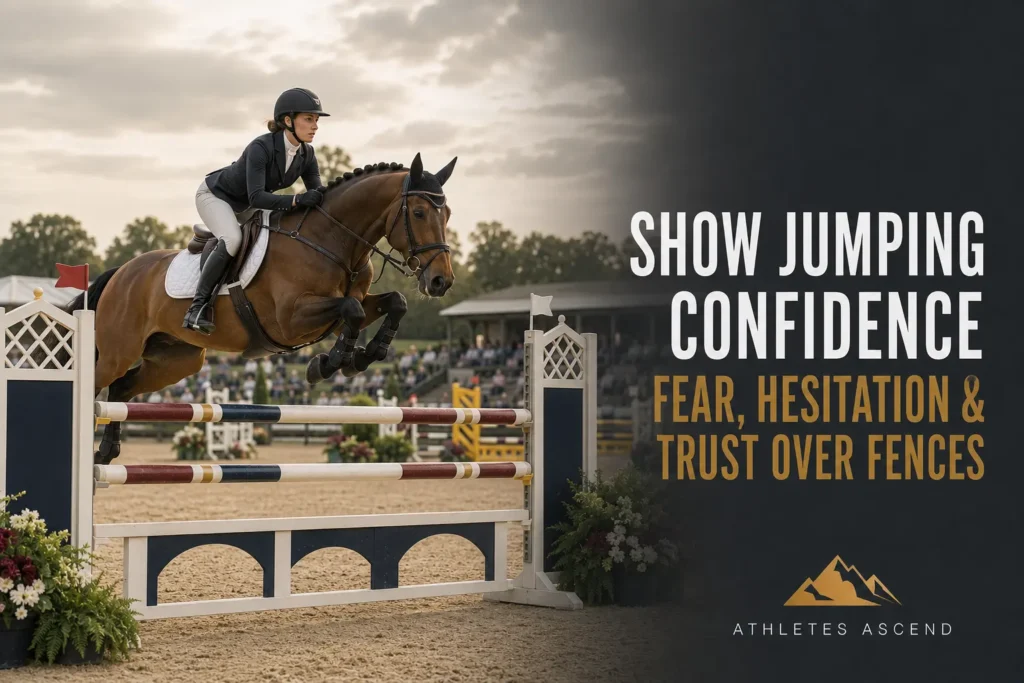
Why Can Confidence Disappear at a Fence?
Confidence may change after a fall, refusal, awkward stride or frightening jump. There does not always have to be one dramatic incident.
A rider may become cautious after uncomfortable rounds. A new horse, increased height or unfamiliar venue can expose uncertainty.
Common influences include:
- Remembering a previous fall or refusal.
- Worrying that the horse will stop.
- Feeling unsure about seeing a stride.
- Becoming tense around particular fences.
- Fear of disappointing other people.
- Trying to control every part of the approach.
Fear and Hesitation During the Approach
Once the rider expects trouble, attention becomes divided.
Part maintains the rhythm. Another part searches for evidence that something will go wrong.
Thoughts may include:
What if the horse stops again?
I cannot see the stride.
These thoughts change breathing, balance and timing, which the rider may interpret as proof they are not ready.
This is how overthinking in sport becomes physical and affects communication with the horse.
The Showjumping Confidence Cycle
Horses respond to changes in balance, contact and commitment. Yet pain, training, footing, equipment and the suitability of the question may also contribute to a refusal.
Expecting a refusal can nevertheless alter the approach. The rider may drive too strongly, restrict with the hand or stop riding positively.
If the horse hesitates, the rider’s fear appears confirmed. The next approach carries even more anticipation, tension and interference. A problem beginning with one fence may then spread to combinations, fillers, oxers or jumping generally, damaging wider sports confidence.
Confidence After a Refusal or Fall
Repeatedly attacking the same fence while anxiety rises may strengthen its association with danger. A qualified instructor can decide whether to try again or simplify the exercise.
After a fall, physical and psychological readiness may develop at different speeds. A rider can be medically recovered without feeling ready to commit. The page on horse-riding confidence after a fall explains this wider return.
Rebuilding Trust in Yourself and Your Horse
Trust does not guarantee that every fence will be perfect. Showjumping always contains uncertainty.
Useful trust means believing that you can decide appropriately, remain present and respond constructively. Waiting to feel completely certain can keep the rider stuck. Confidence often develops through suitable supported experiences.
A qualified instructor should assess the rider, horse and practical situation, then create safe and appropriate progressions.
Mindset coaching supports this process; it does not replace it.
Moving From Control to Commitment
When riders lose confidence, they may supervise every stride, search desperately for the perfect take-off point and repeatedly question whether to continue.
Commitment means making an appropriate decision and riding it clearly—not charging forward or ignoring technical advice.
Developing trust in your training can help the rider move from constant internal checking towards a calmer approach.
How Sports Mindset Coaching May Help
Mindset coaching may help when fear, anticipation and conscious interference affect the rider’s ability to use their existing skills.
Work may include:
- Identifying situations that trigger hesitation.
- Understanding what the rider predicts during the approach.
- Separating genuine risk from learned anticipation.
- Simplifying attention before and between fences.
- Preparing for competition pressure.
- Building progressive evidence with the instructor.
Inner Voice Awareness™ may help when the rider receives one instruction from their coach and several conflicting instructions from themselves.
Flow State Activation™ may support presence and responsiveness. NLP and hypnotherapy for sports performance may also be incorporated appropriately. None replaces safe instruction, veterinary advice or rehabilitation.
Safety, Welfare and Professional Boundaries
Fear is not always an irrational obstacle. Sometimes it is useful information.
Persistent refusals, behavioural changes or unexplained reluctance may require assessment from an instructor, veterinarian, physiotherapist, saddle fitter or another qualified practitioner. Responsible support asks what needs attention rather than assuming the rider simply needs confidence.
Coach’s Insight
The rider often asks:
How do I stop being frightened before the fence?
A more useful question may be:
What would help me ride the approach clearly even if some uncertainty is present?
Confidence is remaining connected to the horse, the decision and the next action without allowing fear to take over.
Frequently Asked Questions
Why have I suddenly lost my confidence jumping?
Confidence can change after a fall, refusal, difficult round, increased height, new horse or period away from jumping. Sometimes several smaller experiences accumulate.
Should I keep jumping until I overcome the fear?
Not automatically. Repetition should be safe, appropriately graded and guided by a qualified instructor. Repeated attempts while fear escalates may make the association stronger.
Can mindset coaching replace showjumping lessons?
No. It addresses confidence, attention, pressure and anticipation. Technical instruction should come from an appropriately qualified equestrian coach.
Riding Towards the Fence With Greater Trust
Losing confidence can make a capable rider question everything. Recovery begins by understanding what changed, checking the foundations and rebuilding trust appropriately.
The wider process may connect with equestrian performance psychology, dressage performance psychology or rebuilding eventing confidence and cross-country trust, depending on the rider’s discipline and situation.
The goal is to approach the fence with enough clarity, trust and commitment to ride the situation actually in front of you.
Call +44 07807 540142 or email me