You know the jump.
You may have landed it repeatedly, completed it in a harness or performed it confidently before an injury or break. Yet as you approach the entry, your body does something different.
You circle without attempting it. You slow down, pull back, open early or turn a planned double into a single. Sometimes you do not take off at all.
Skaters often describe this as a jump mental block.
It can be frustrating because the skill has not necessarily disappeared. The difficulty lies in committing to a movement that feels unsafe, uncertain or over-controlled.
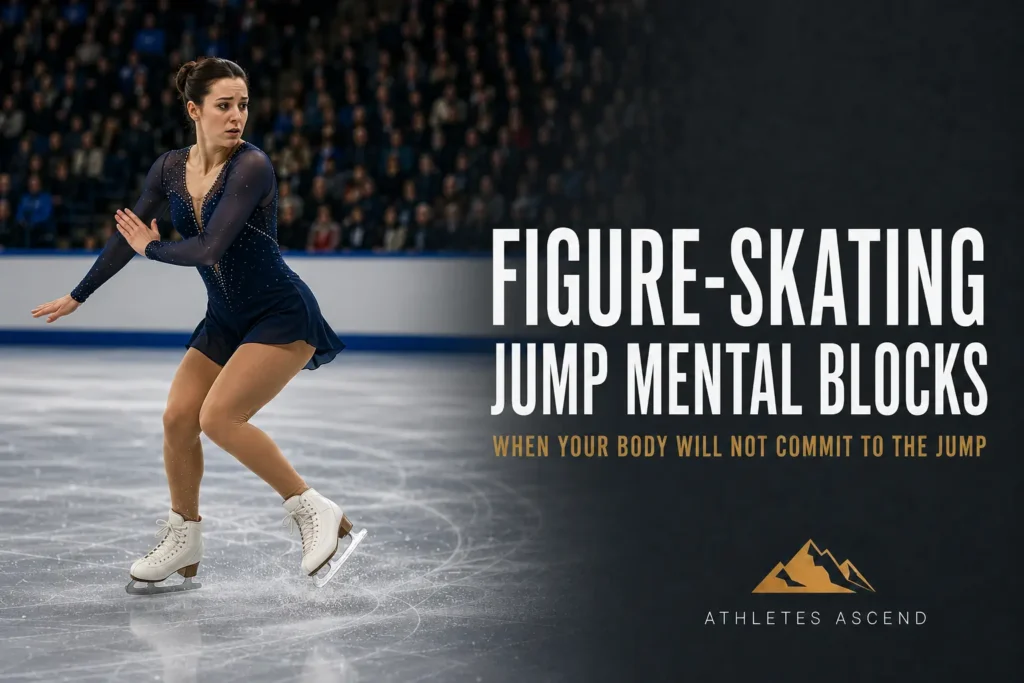
What Does a Figure-Skating Jump Mental Block Look Like?
A skater may experience:
- Popping a double or triple jump into a single.
- Circling repeatedly without making an attempt.
- Slowing down before the entry.
- Landing the jump in a harness but not independently.
- Pulling out as soon as rotation begins.
- Freezing before an Axel or another forward take-off.
- Attempting the jump in practice but avoiding it in a programme.
- Becoming afraid after a fall or injury.
- Losing one jump while others remain unaffected.
Searches such as “why do I keep popping my jumps?”, “scared to attempt my Axel” and “I can do the jump in a harness but not alone” describe different problems. The block needs to be understood rather than given one universal solution.
Is the Problem Technical, Physical or Psychological?
Not every aborted jump is a mental block.
Timing, edge quality, speed, take-off, rotation and physical readiness all matter. Growth, injury, fatigue, equipment and time away can change a previously reliable skill.
A skating coach should assess the jump. Pain, dizziness or physical limitation may require medical or physiotherapy support.
However, technique can become the focus of excessive conscious control. The skater tries to supervise the entry, edge, arms, take-off, rotation and landing simultaneously. This can become overthinking in sport rather than useful technical attention.
Why Does a Skater Pop a Jump?
“Popping” means opening early or not committing to the intended rotation. It can occur when the mind predicts danger or failure before take-off.
A common cycle is:
- A jump produces a hard fall, near miss or frightening sensation.
- The next approach carries greater anticipation.
- The skater becomes tense and consciously monitors the movement.
- Commitment reduces at take-off.
- The jump is popped, stopped or under-rotated.
- The result appears to prove that the jump is no longer safe or reliable.
Repeated popping can damage sports confidence beyond the original jump. Each approach becomes a test of whether the block is still there.
Fear of Falling, Injury or Getting Lost in the Air
The skater may not fear the same thing every time.
One fears the impact of falling. Another worries about repeating an injury. A third dislikes the moment of being backwards, rotating or unable to see the landing.
Some skaters fear disappointing others or losing a programme element, competition level or identity as a capable skater. This connects the block with fear of failure in sport.
Identifying the feared moment creates a more precise starting point. “I have lost my Axel” is broad. “I pull away when I reach the forward take-off because I expect to fall backwards” is workable.
What Elite Skaters Have Used
Elite skaters are not immune to fear or psychological disruption.
After a hard fall, American champion Amber Glenn’s fear of injury led her to put the triple Axel aside temporarily. U.S. Figure Skating’s account of her eventual return to the jump describes off-ice work, harness training, physical preparation and gradual recommitment.
Glenn has also discussed breathing exercises and neurofeedback recommended through psychological support to help regulate anxiety and regain focus.
After serious jump errors under Olympic pressure in 2018, Nathan Chen worked with sports psychologist Erik Potterat and changed his approach to pressure before winning Olympic gold in 2022. His experience shows how technical ability can become less accessible when pressure dominates attention.
Isabeau Levito has described coordinating breaths through her programme to support rhythm and manage tension before difficult elements.
The methods differ, but they share a principle: mental preparation supports the trained movement; it does not replace it.
Rebuilding the Jump Without Constantly Testing It
The skater may arrive at every session asking:
Can I do it today?
Every attempt then becomes a verdict. A pop means the problem is worse; one landing must be repeated immediately to prove it was not luck.
With a qualified skating coach, practice may move away from constant testing. Progressions might use preparatory exercises, simpler rotations, off-ice work, a harness or carefully selected attempts. These are technical decisions for the coach.
Psychologically, progression should produce credible evidence without repeated overwhelming attempts. This is part of rebuilding confidence in sport, not permanently lowering standards.
Attention Before Take-Off
As the jump approaches, the skater may think:
- Do not pop.
- Keep the edge.
- Pull in.
- Do not fall.
- Everyone is watching.
Five instructions cannot all lead attention.
Effective focus in sport is selective. The skating coach may choose one appropriate cue. Mindset coaching can help the skater use it without turning it into another condition that must feel perfect before attempting the jump.
Breathing or rhythm may also provide a transition from decision into action. Mindfulness in sport can help the skater notice fear without treating it as an automatic command to abort.
Pressure, Judgement and Competition
A jump may work in an empty practice rink and disappear once other skaters, coaches or judges are present.
Being watched increases self-consciousness. The skater may wait for clear ice or worry that everyone has noticed the block. In competition, one element can appear to determine the programme.
This can create performance anxiety in sport. Progress therefore needs eventually to transfer from protected practice into programmes, observation and competition pressure without increasing every demand at once.
Can NLP or Hypnotherapy Help?
Some jump blocks feel automatic: the skater wants to attempt the jump, but another response interrupts the movement.
Where appropriate, NLP or hypnotherapy may explore meanings attached to a fall, anticipatory imagery, internal language and learned fear. They may support calmer rehearsal and attentional control.
They do not replace technical coaching, safe progressions, medical care or physical preparation. No responsible practitioner should promise to remove sensible caution or guarantee a jump. My approach to NLP and hypnotherapy for sports performance explains these boundaries more fully.
How Sports Mindset Coaching May Help
Mindset coaching may help the skater:
- Identify exactly where commitment changes.
- Understand thoughts and sensations before the pop or freeze.
- Reduce fear attached to an imperfect attempt.
- Develop one clear attentional cue.
- Respond differently after a fall or aborted jump.
- Prepare for being watched and judged.
- Build confidence from progressive evidence.
- Improve emotional control in sport.
Developing Inner Voice Awareness™ may be particularly helpful when several conflicting instructions appear during the approach. Some skaters think in words; others respond more strongly to rhythm, sensation or imagery. Support should reflect the individual.
Coach’s Insight
The skater often asks:
How do I make myself do the jump?
A more useful question may be:
What would allow me to approach, commit and respond without demanding certainty first?
Confidence is not knowing that you will land. It is being able to make an appropriate attempt while accepting that skating contains uncertainty.
Frequently Asked Questions
Why can I land the jump in a harness but not without it?
The harness changes perceived risk and confidence. Your coach should also confirm that the independent jump is technically and physically ready.
Should my coach keep making me attempt it?
Repeated attempts are not always productive. The coach should consider technique, safety, fatigue, fear and whether the current progression is appropriate.
Does popping mean I am not trying hard enough?
No. Popping can involve fear, timing, technique, fatigue or conscious interference. More pressure may intensify the pattern.
Can mindset coaching guarantee I will regain the jump?
No. It may help when fear, attention and anticipation contribute, but technical and physical factors remain essential.
Trusting the Jump Again
A mental block can make a capable skater feel separated from a familiar movement.
Progress begins by identifying what is technical, physical and psychological. From there, the skating coach can guide safe skill development while mindset support addresses fear, attention, pressure and learned anticipation.
The goal is not to force the jump or guarantee the landing.
It is to create the conditions in which the skater can prepare, commit and trust their training again