Neuro-Linguistic Programming, usually known as NLP, is a coaching approach that explores how our thoughts, language, emotions and behaviours influence the way we experience the world.
Developed during the 1970s, NLP grew from an interest in understanding why some people consistently achieved exceptional results. Rather than concentrating on problems alone, it explored how successful people think, communicate and behave, and whether those patterns could be understood and applied by others.
Today, NLP is used by many coaches, therapists, trainers and business professionals to help people improve confidence, communication, emotional regulation, performance and personal development.
At Athletes Ascend, NLP forms one part of a broader, evidence-informed coaching approach. It sits alongside sports psychology, practical coaching experience and performance science to help athletes understand themselves and perform more consistently.
Call +44 07807 540142 or email me
Book Your Session
Ask a Question
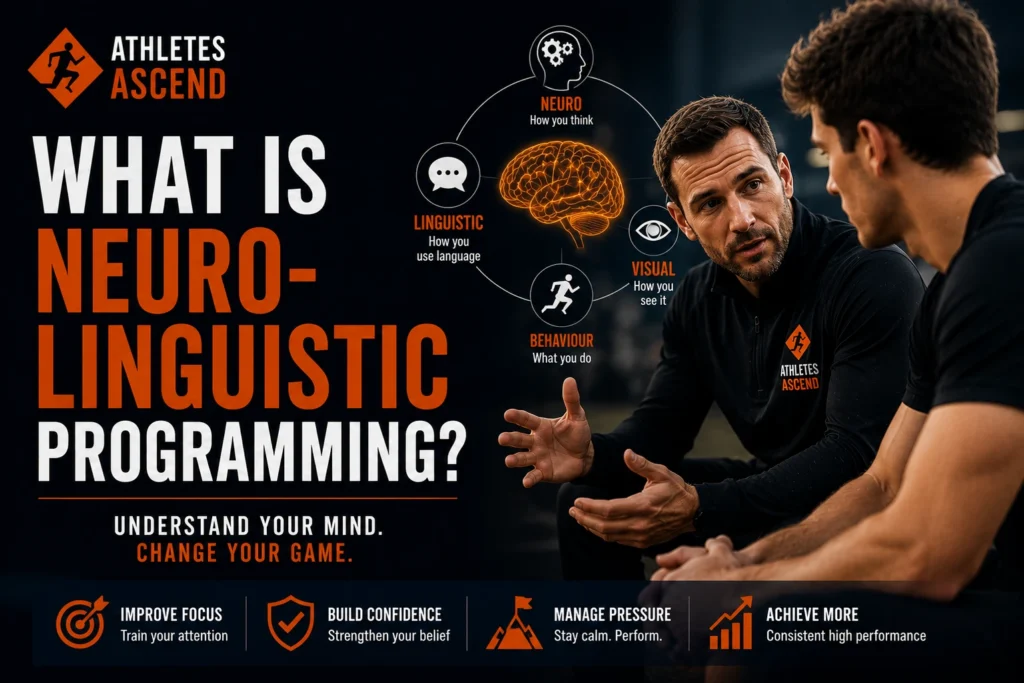
What Does Neuro-Linguistic Programming Mean?
Although the name sounds technical, it can be understood quite simply.
Neuro refers to the way we experience the world through our brain and nervous system.
Linguistic refers to language—both the words we use when communicating with others and the internal dialogue we have with ourselves. Self-talk happens here.
Programming refers to the patterns and habits we develop over time. Some of these patterns support success. Others become unhelpful and limit performance.
NLP is interested in recognising those patterns and developing more useful alternatives.
The Core Principles of NLP
While different practitioners have different approaches, several ideas are central to NLP.
Behaviour Has a Structure
NLP suggests that successful performance is rarely random.
Thoughts, emotions and behaviours often follow recognisable patterns.
Understanding those patterns makes it easier to repeat success and change unhelpful habits.
The Map Is Not the Territory
One of the best-known NLP principles is:
“The map is not the territory.”
In simple terms, people do not respond directly to reality.
They respond to their interpretation of reality.
Two athletes can experience exactly the same event yet react completely differently because each interprets it in their own way.
Changing interpretation often changes emotional response.
State Influences Performance
Our emotional and mental state affects how well we think, communicate and perform.
When athletes feel calm, confident and focused, they often perform closer to their potential.
When they become overwhelmed by anxiety, frustration or self-doubt, performance may suffer.
Learning to recognise and influence state is an important part of NLP coaching.
People Already Have Resources
NLP often assumes that people already possess many of the internal resources they need.
The challenge is learning how to access those resources more consistently.
This strengths-based approach encourages coaches to build upon existing abilities rather than focusing only on weaknesses.
Common NLP Techniques
NLP includes many practical tools. Coaches use different techniques depending on the individual and the situation.
Some of the best-known include:
Goal Setting
Creating outcomes that are clear, meaningful and motivating rather than vague or unrealistic.
Reframing
Looking at situations from a different perspective.
Changing the meaning attached to an event can often change the emotional response to it.
Anchoring
Developing reliable associations between helpful emotional states and specific cues through repetition and practice.
Modelling Excellence
Studying how highly successful people think and behave so that useful strategies can be adapted by others.
Perceptual Positions
Exploring situations from different viewpoints to improve understanding, empathy and decision making.
Rapport
Developing trust and effective communication through attentive listening, flexibility and understanding.
Language Patterns
Recognising how language influences thoughts, emotions and behaviour, both when communicating with others and through self-talk.
NLP in Performance Coaching
Performance coaching often focuses on helping people perform consistently rather than simply solving problems.
NLP can contribute by helping individuals:
Build confidence.
Reduce unhelpful thinking.
Improve emotional regulation.
Strengthen communication.
Clarify goals.
Improve focus.
Develop resilience.
Recover more effectively from setbacks.
Many of these areas are particularly relevant within sport.
NLP in Performance Coaching
Performance coaching often focuses on helping people perform consistently rather than simply solving problems.
NLP can contribute by helping individuals:
- Build confidence.
- Reduce unhelpful thinking.
- Improve emotional regulation.
- Working on the neurological levels.
- Strengthen communication.
- Clarify goals.
- Improve focus.
- Develop resilience.
- Positive psychology.
- Recover more effectively from setbacks.
Many of these areas are particularly relevant within sport.
NLP at Athletes Ascend
At Athletes Ascend, NLP is not viewed as a standalone solution.
Instead, it works alongside:
- Inner Voice Awareness.
- Flow State Activation.
- Identity development.
- Emotional regulation.
- Mindset.
- Sports psychology.
- Goal setting.
- Performance coaching.
Every athlete is different.
The aim is never to force techniques onto someone.
The aim is to understand how each athlete naturally thinks and then develop strategies that suit them.
NLP Insight
The way you experience an event is often shaped as much by your interpretation as by the event itself.
Understanding that gives you more choices.
Coach’s Observation
One of the most valuable lessons I’ve learned through NLP is that lasting improvement rarely comes from trying harder alone.
It comes from understanding how people think, how they create meaning from experiences and how small changes in thinking can influence confidence, behaviour and performance over time.
A Balanced Perspective
NLP has influenced coaching, communication and personal development for decades.
Many practitioners and clients report positive experiences using NLP techniques.
At the same time, scientific research has found mixed evidence for NLP as a complete system, and some of its original claims have not been consistently supported by high-quality research.
For that reason, Athletes Ascend uses NLP thoughtfully—as one practical coaching framework alongside established psychological principles, coaching experience and individualised performance strategies.
Frequently Asked Questions
Is NLP the same as sports psychology?
No. Sports psychology is an established scientific discipline. NLP is a coaching framework. While there is overlap in some practical techniques, they are not the same.
Does NLP work for everyone?
No single coaching approach works for everyone. Some athletes find NLP techniques highly valuable, while others benefit more from different methods or a combination of approaches.
Is NLP evidence-based?
Individual techniques used within NLP overlap with methods supported in wider psychology. However, research evaluating NLP as a complete model has produced mixed findings.
Can NLP improve confidence?
Many people use NLP techniques to help improve confidence, communication, emotional regulation and performance, although results vary between individuals.
Why does Athletes Ascend use NLP?
Because it provides practical tools that, when combined with sports psychology, coaching experience and personalised support, can help many athletes better understand themselves and perform more consistently.
Understanding Yourself Is the First Step Towards Better Performance
Whether you’re competing at club level or striving for elite performance, the way you think influences the way you perform.
NLP offers one practical framework for understanding those thought patterns and developing more effective ways of responding to pressure, challenge and opportunity.
At Athletes Ascend, we combine NLP with evidence-informed coaching and practical performance strategies to help athletes build confidence, improve consistency and perform closer to their true potential. Inner Voice Awareness™ and Flow State Activation™ will make all of this possible.
Call +44 07807 540142 or email me