Every athlete has conversations.
Some happen with coaches.
Some happen with teammates.
The most important conversations, however, often happen inside your own mind.
Whether you realise it or not, the way you speak to yourself influences confidence, focus, emotional control and decision making. Supportive self-talk can help you recover after mistakes, stay calm under pressure and maintain belief in your ability. Negative or unhelpful self-talk can increase anxiety, fuel overthinking and make even simple skills feel difficult.
The objective isn’t to think positively all the time. The objective is to develop self-talk that is realistic, constructive and helps you perform at your best.
Call +44 07807 540142 or email me
Book Your Session
Ask a Question
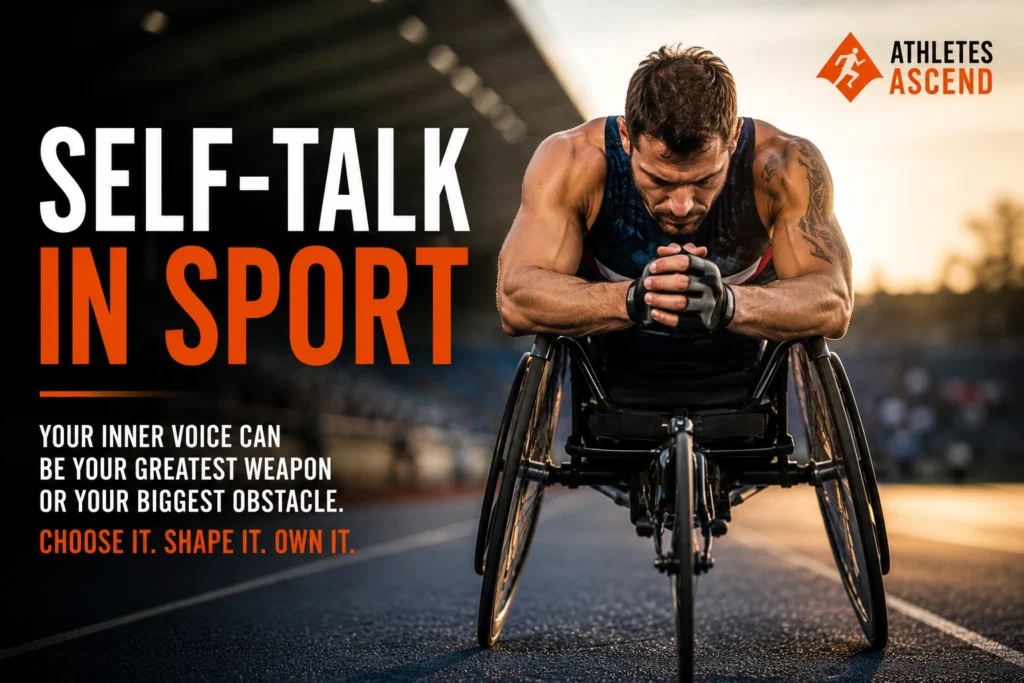
What Is Self-Talk?
Self-talk is the internal dialogue that runs through your mind before, during and after performance.
It might sound like:
- “I’ve prepared for this.”
- “Stay with the next play.”
- “You’ve done this before.”
- “Keep going.”
Or it may become more critical:
- “Don’t mess this up.”
- “You’re playing terribly.”
- “Everyone’s watching.”
- “You’re not good enough.”
The important thing isn’t whether thoughts appear.
It’s how much influence you allow them to have.
Why Self-Talk Matters
Your inner dialogue affects more than your mood.
It influences:
- Confidence.
- Focus.
- Emotional control.
- Decision making.
- Overthinking.
- Motivation.
- Recovery after mistakes.
- Performance under pressure.
Athletes who consistently speak to themselves in constructive ways often recover more quickly from setbacks and maintain greater consistency throughout competition.
Not All Negative Thoughts Are Problems
One of the biggest misconceptions in sport is that successful athletes never experience negative thoughts.
They do.
The difference is that they don’t automatically believe every thought that enters their mind.
A thought such as:
“What if I fail?”
is simply a thought.
It isn’t a prediction.
Learning to notice thoughts without becoming controlled by them is one of the most valuable psychological skills an athlete can develop.
Changing the Conversation
Improving self-talk isn’t about replacing every negative thought with an unrealistic positive one.
Instead, it’s about creating a more helpful internal dialogue.
For example:
Instead of:
“I can’t do this.”
Try:
“Focus on the next action.”
Instead of:
“I always choke.”
Try:
“One moment doesn’t define my performance.”
Instead of:
“Don’t make a mistake.”
Try:
“Commit fully to the skill.”
Constructive self-talk directs attention towards performance rather than fear.
Self-Talk and Performance
The words you repeat consistently often influence where your attention goes.
If your inner dialogue constantly focuses on mistakes, your attention naturally follows.
If it focuses on preparation, effort and the next action, performance often becomes calmer and more consistent.
This doesn’t mean words possess magical power.
It means attention influences behaviour, and behaviour influences performance.
This works even if you have anendophasia.
Every Athlete Is Different
Not everyone experiences self-talk in the same way.
Some athletes have a constant internal dialogue.
Others think more through feelings, sensations or mental imagery.
Some people experience very little internal speech at all.
Understanding how your own mind works is often more valuable than trying to copy someone else’s approach.
This is one reason why personalised coaching can be so effective.
Self-Talk Insight
You speak to yourself more than anyone else ever will.
Make sure you’re helping your performance—not fighting against it.
Coach’s Observation
The most successful athletes rarely have the kindest inner voice.
They often have the most useful one.
Instead of demanding perfection, they repeatedly guide their attention back towards what helps them perform.
How Sports Mindset Coaching Can Help
Developing healthier self-talk involves far more than repeating positive phrases.
Sports mindset coaching helps athletes recognise unhelpful thinking patterns, develop more effective internal dialogue and strengthen confidence through practical strategies that can be used during both training and competition.
At Athletes Ascend, we also explore how self-talk connects with Inner Voice Awareness™ —understanding your internal dialogue before attempting to change it. Flow State Activation™ will follow.
Awareness always comes before improvement.
Frequently Asked Questions
Is self-talk important in sport?
Yes. Self-talk influences confidence, focus, emotional regulation, motivation and decision making, making it one of the most important psychological skills athletes can develop.
Do elite athletes use self-talk?
Yes. Many elite athletes deliberately use cue words, performance reminders and constructive internal dialogue to maintain focus during competition.
Should I try to eliminate negative thoughts?
Not necessarily. Negative thoughts are normal. The aim is to stop them controlling your attention and behaviour.
What if I don’t have an inner voice?
Not everyone experiences self-talk in the same way. Some athletes think primarily through feelings, visual imagery or other mental processes. Effective coaching should always be adapted to the individual.
Can sports mindset coaching improve self-talk?
Absolutely. Athletes can learn to recognise unhelpful thinking patterns, strengthen confidence and develop an internal dialogue that supports rather than disrupts performance.
How I Work With Athletes
I combine practical sports mindset coaching with NLP, hypnotherapy where appropriate, and performance-psychology principles. The approach depends on the athlete, the sport and what is maintaining the problem. It complements technical coaching, medical care and rehabilitation rather than replacing them.
Change the Conversation, Change the Performance
The way you speak to yourself influences the way you compete.
When your internal dialogue becomes calmer, clearer and more constructive, confidence grows, focus improves and performance often becomes more consistent.
At Athletes Ascend, we help athletes understand their inner dialogue, NLP, develop healthier self-talk and build the mindset needed to perform at their very best.
Call +44 07807 540142 or email me