Many athletes are encouraged to improve their self-talk.
They’re told to:
“Stay positive.”
“Tell yourself you can do it.”
“Use positive affirmations.”
But what if you don’t naturally experience an internal voice at all?
Some people experience little or no internal monologue, a phenomenon often referred to as anendophasia.
If this describes you, there is nothing wrong with the way your mind works.
It simply means your thinking may rely less on internal speech and more on other forms of processing.
Athletes don’t all think in the same way.
Successful coaching should reflect that.
Call +44 07807 540142 or email me
Book Your Session
Ask a Question
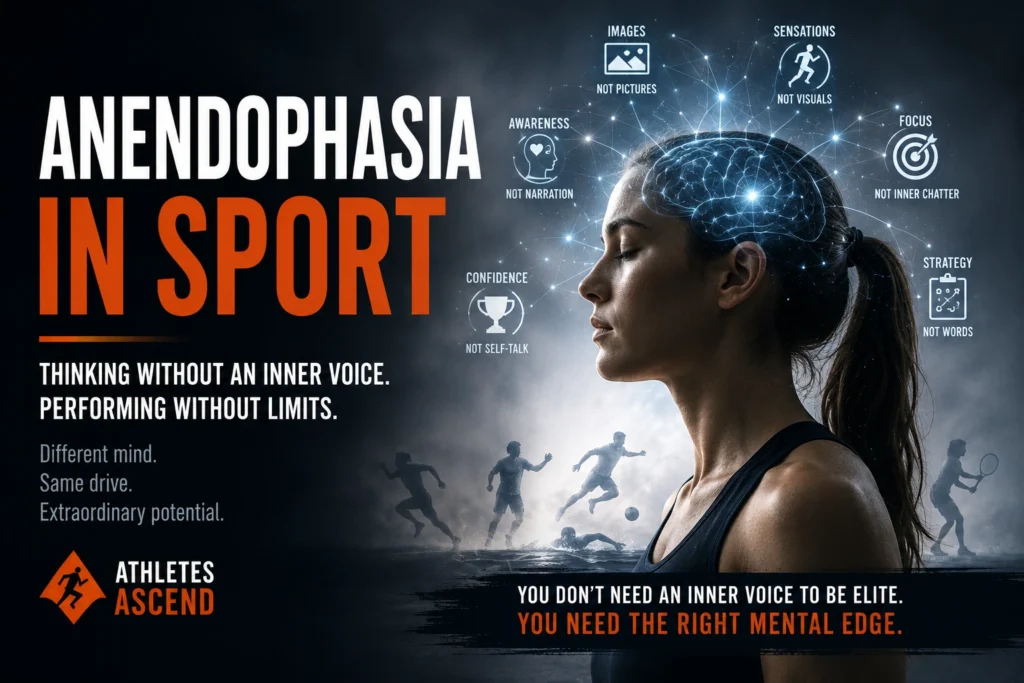
What Is Anendophasia?
Anendophasia refers to having little or no conscious inner speech.
People with anendophasia may not experience the ongoing internal conversations that many others describe.
Instead, they may think through:
- Feelings.
- Physical sensations.
- Concepts.
- Movement.
- Intuition.
- Recognition.
- Direct understanding.
Thinking without an inner voice is simply another way that the human mind can operate.
Can Athletes Without an Inner Voice Perform Well?
Absolutely.
An inner voice is not a requirement for sporting success.
Athletes without an internal monologue often rely on:
- Automatic movement.
- Physical awareness.
- Timing.
- Pattern recognition.
- Instinctive decision making.
- Repetition.
- Experience.
Many sports reward these abilities.
In some situations, having less internal commentary may even reduce overthinking during performance.
When Traditional Advice Doesn’t Fit
Much sports psychology assumes every athlete has an inner voice.
Advice such as:
“Change what you say to yourself.”
or
“Repeat positive affirmations.”
may feel confusing if you don’t naturally think that way.
The issue isn’t your mind.
The issue is applying techniques that weren’t designed for your style of thinking.
Different Minds Need Different Strategies
Athletes without an inner voice often benefit from approaches such as:
- Physical rehearsal.
- Consistent routines.
- Breathing techniques.
- Emotional awareness.
- Movement-based learning.
- Environmental cues.
- Using mindfulness.
- Process-focused practice.
- Developing trust in automatic performance.
The aim is always to work with your natural strengths rather than against them.
Understanding Your Own Mind
There is no single “correct” way to think.
Some athletes rely heavily on internal dialogue.
Others visualise vividly.
Some do both.
Some experience neither.
Understanding how your own mind naturally processes information allows you to develop mental training that genuinely fits you.
This personalised approach sits at the heart of Athletes Ascend.
Anendophasia Insight
You don’t need an inner voice to become an outstanding athlete.
You need strategies that match the way your own mind works.
Coach’s Observation
One of the biggest mistakes in performance coaching is assuming every athlete thinks the same way.
The most effective coaching begins by understanding how an individual experiences the world, then building practical strategies around that.
There is no one-size-fits-all mind. This is known in NLP.
How Sports Mindset Coaching Can Help
At Athletes Ascend, we don’t assume every athlete visualises or experiences an inner voice.
Instead, coaching is adapted to your individual way of thinking.
Whether you process information through movement, emotion, concepts, physical awareness or internal dialogue, the goal is the same:
To help you perform consistently, confidently and naturally enabling flow state.
Frequently Asked Questions
What is anendophasia?
Anendophasia describes having little or no conscious inner speech or internal monologue. Research into this area is still developing, and people’s experiences vary considerably.
Can athletes without an inner voice succeed?
Yes. Sporting success depends on many different abilities. An internal monologue is not essential for elite performance.
Does everyone think with words?
No. Human thinking is highly varied. Some people think mainly with language, others with imagery, feelings, movement, concepts or combinations of these.
Is anendophasia the same as aphantasia?
No. Aphantasia relates to mental imagery, while anendophasia relates to internal speech. Some people experience one, both or neither.
Can sports mindset coaching help?
Yes. Effective coaching should be adapted to how each athlete naturally thinks rather than assuming everyone uses the same mental processes.
How I Work With Athletes
I combine practical sports mindset coaching with NLP, hypnotherapy where appropriate, and performance-psychology principles. The approach depends on the athlete, the sport and what is maintaining the problem. It complements technical coaching, medical care and rehabilitation rather than replacing them.
Your Mind Is Unique
The best mental training isn’t based on someone else’s way of thinking.
It’s based on understanding your own.
At Athletes Ascend, we help athletes discover how their minds naturally work and develop personalised strategies that build confidence, improve performance and unlock their potential—whether they think with words, images, movement, feelings or something entirely different.
Call +44 07807 540142 or email me