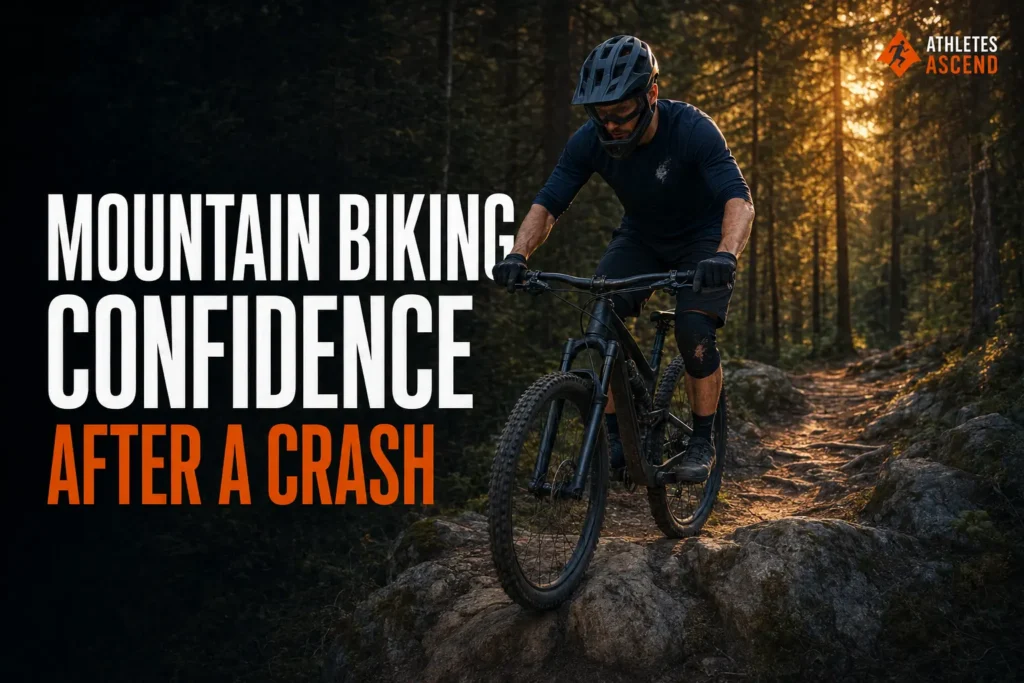
A mountain bike crash can change the way an entire trail feels.
You may be physically recovered and comfortable on easier routes. Yet near a jump, drop or technical feature, your body tightens. You hesitate, brake or avoid that part of the trail.
Losing confidence after a mountain bike crash doesn’t mean you’ve lost your ability or become mentally weak. Your mind and body have learned that a particular movement, feature or loss of control can lead to pain and injury.
The aim isn’t to remove sensible fear or encourage unnecessary risks. It is to understand the response, rebuild relevant skills and ride according to what is happening now—not only what happened during the crash.
Call +44 07807 540142 or email me
Book Your Session
Ask a Question
Why Can a Mountain Bike Crash Affect Confidence So Strongly?
Mountain biking combines speed, balance, changing surfaces and genuine consequence. The mind may remember:
- Choosing the wrong line or hesitating.
- Losing grip on roots, rocks, mud or loose ground.
- The impact, pain or rehabilitation afterwards.
Even when medically ready, the trail can activate that memory. This is a psychological return after a crash, complicated because no two trails or attempts are identical.
The Fear May Be Linked to One Exact Feature
You may not have lost confidence everywhere.
Perhaps you ride flowing singletrack but freeze before drops, steep ground or the type of gap where you crashed.
Common triggers include:
- Jumps and gap jumps.
- Drops and rock steps.
- Steep technical descents.
- Berms and fast corners.
- Wet roots, loose surfaces or exposed trails.
- Returning to the location of the crash.
General sports confidence advice may help, but “be more confident” doesn’t explain the seconds before you brake or freeze. A precise trigger enables a relevant return.
If speed and cornering on the way down are the main difficulty, see fear of descending after a cycling crash
Is It Fear, Technique or a Genuine Warning?
Fear after a crash is not automatically irrational.
First ask:
- Have you received appropriate medical guidance?
- Has the bike, helmet and other equipment been properly checked?
- Do you understand why the crash happened?
- Is your present technique suitable for the feature?
- Have trail conditions changed?
- Is the feature within your current ability?
A mountain bike coach can assess technique, a mechanic the bike, and medical professionals physical readiness. Psychological coaching works alongside them.
Fear may disrupt sound technique, or a technical weakness may create appropriate fear. Often both are involved.
How Fear Can Change Your Riding
The mind’s attempt to protect you can alter the way you move.
You may over-grip, become rigid, stare at the obstacle or brake late after too much hesitation. Previously automatic movements become consciously controlled.
This can create a cycle:
- You approach the feature and remember the crash.
- Your body becomes tense and attention narrows.
- You brake, hesitate or change position.
- The bike feels less natural and responsive.
- That experience seems to confirm that the feature is unsafe.
- Fear increases before the next attempt.
This is overthinking in sport. The skill may remain, but excessive control makes it harder to access.
Commitment Does Not Mean Recklessness
Mountain bikers talk about “committing” to a feature. Last-second hesitation, abrupt braking or changing a decision midway can interfere with technique.
However, “just commit” is not complete advice.
Commitment should follow assessment, sound technique, a checked bike and appropriate progression. It never means forcing something beyond your skill or ignoring a valid warning.
The goal is informed commitment: deciding early enough to use trained technique. That means trusting your preparation without abandoning judgement.
Rebuilding Confidence Through Progressive Experience
Confidence grows through relevant evidence. Easy trails can restore enjoyment, but progression eventually needs to approach the trigger—not necessarily the exact jump or hardest version.
Depending on your medical and technical readiness, you might:
- Re-establish movement and braking on simple terrain.
- Work with a coach on the specific skill involved in the crash.
- Begin with a smaller, rollable or lower-consequence version of the feature.
- Inspect the approach, landing and exit before riding.
- Repeat manageable attempts until movement feels familiar.
- Increase only one demand at a time: height, speed, gradient or complexity.
- Stop when fatigue or conditions make further attempts unhelpful.
The challenge must be meaningful but manageable. Too little may not build relevant confidence; too much may reinforce fear.
This is confidence rebuilt through evidence, not bravery.
Trusting Your Body, Bike and Decisions Again
After a crash, trust can be lost in several places.
Your body: Will the injured area tolerate the movement involved?
Your bike: Can you trust its brakes, suspension and tyres?
Your technique: Do you have the skill required for this feature today?
Your decisions: Can you assess a line and choose whether to ride or walk?
Each needs evidence. Coming back after injury rebuilds physical capacity, technical coaching rebuilds skill, and psychological work helps when the crash still dominates.
Managing Attention on the Trail
Forcing fear away can make you monitor it more closely.
“Why am I still nervous?”
“What if I freeze again?”
You do not need a perfectly calm or silent mind to ride well. You need attention that supports your next decision.
Return attention to the trail, line, approach and technical cues. Mindfulness in sport helps you notice a reaction without treating it as a command.
Your self-talk should support assessment, not pressure you with “don’t crash” or “you have to.”
Walking can be intelligent; riding should be deliberate.
What If a Return Ride Goes Badly?
A difficult ride doesn’t make the problem permanent. The step may have been too large, conditions changed or group pressure affected you.
Ask when the response began and what changed in your movement, then adjust the next step.
This is part of responding resiliently to setbacks, rather than expecting recovery to follow a perfect line.
Coach’s Insight
I have worked with cyclists whose fear remained after crashes. Feeling confident while talking isn’t the same as accessing confidence when speed, terrain and consequence become real.
If fear returns, the work hasn’t automatically failed. The step may be too large, the trigger insufficiently specific or technical confidence unfinished.
The aim isn’t to make a mountain biker fearless. It is to help them assess what is happening now and make clear decisions without the previous crash automatically taking control.
How Sports Mindset Coaching Can Help
Mindset coaching may help identify the trigger, understand how the crash affects movement, respond to protective thoughts and create a progression alongside technical coaching.
It can also address comparison and pressure from riding partners.
If anxiety becomes panic, understanding panic in sport may help. Intrusive memories, nightmares or severe distress beyond mountain biking may require a qualified mental health professional.
Frequently Asked Questions
Should I Ride the Feature Where I Crashed Again?
Not automatically. Understand the crash, check readiness and decide whether it remains appropriate. Repeating it is not a compulsory test of courage.
Is It Normal to Lose Confidence After a Mountain Bike Crash?
Yes. It can reduce trust in your body, bike, technique or decisions. Confidence may remain low around one feature.
Should I Just Force Myself to Commit?
No. Commitment should follow assessment, skill and progression. Forcing a feature while uncertain can reinforce fear and risk.
Can a Mountain Bike Coach Help With Fear?
A qualified coach can assess technique and create skill progressions. Psychological coaching may help when fear continues despite suitable preparation.
What If My Friends Are Pressuring Me to Ride It?
Group encouragement can help, but pressure can rush judgement. Walking is preferable to attempting it for the wrong reason.
Does Post-Crash Fear Mean I Have PTSD?
No. Fear can be normal after a crash. PTSD is a clinical condition and shouldn’t be assumed from a sport-specific block.
How I Work With Athletes
I combine practical sports mindset coaching with NLP, hypnotherapy where appropriate, and performance-psychology principles. The approach depends on the athlete, the sport and what is maintaining the problem. It complements technical coaching, medical care and rehabilitation rather than replacing them.
Return With Skill, Trust and Control
A crash can make familiar trails feel unfamiliar. But losing confidence doesn’t necessarily mean losing ability. Your system may still be protecting you from something that has already happened.
With medical clearance, a safe bike, skills coaching and psychological work, you can respond to the trail as it is now—not only to the crash you remember.
At Athletes Ascend, I help athletes understand what is maintaining fear, rebuild confidence through meaningful evidence and return with greater trust, awareness and control.
Call +44 07807 540142 or email me