Target panic does not always look like panic.
An archer may appear calm while being unable to settle the sight on the gold. Another reaches anchor and releases immediately. Some freeze below or beside the target. Others punch the trigger, collapse through the shot or feel an overwhelming need to release before they are ready.
The archer often understands exactly what a good shot should feel like. They may be able to demonstrate it while blank-bale shooting or rehearsing without an arrow. Yet the moment aiming and consequence return, the process changes.
Archery target panic is therefore not simply a lack of knowledge. It is a disruption in the relationship between aiming, anticipation and executing the shot.
Call +44 07807 540142 or email me
Book Your Session
Ask a Question
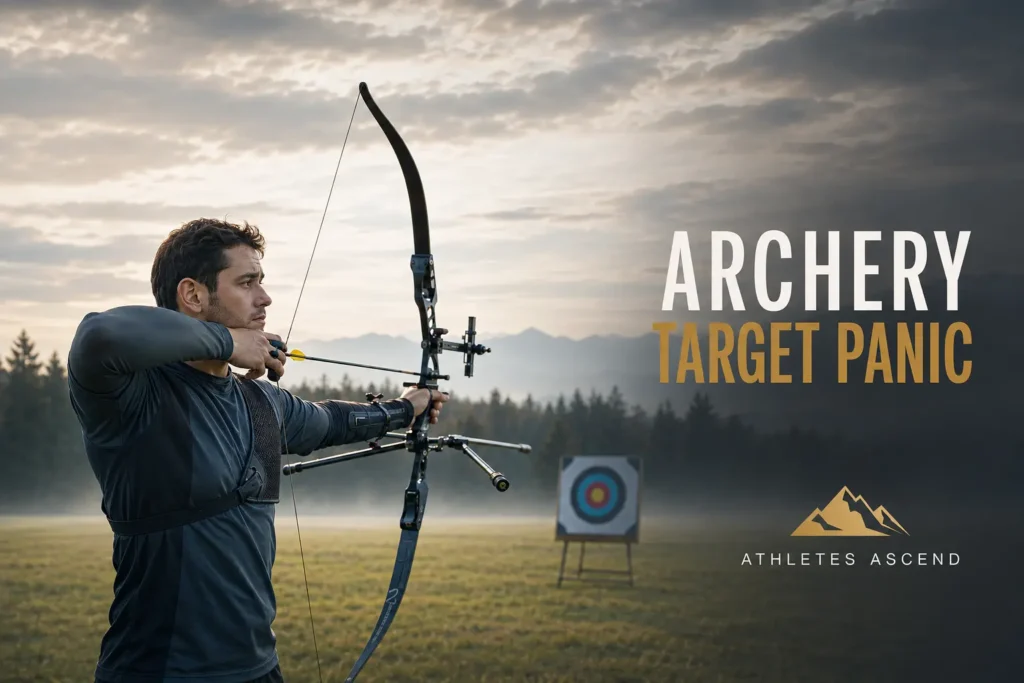
What Is Target Panic in Archery?
Target panic is a broad term describing involuntary or difficult-to-control changes in the shooting process when an archer aims at a target.
It can include:
- Releasing as soon as the sight reaches the target.
- Being unable to move the sight onto the gold.
- Freezing above, below or beside the intended point.
- Punching or grabbing the release aid.
- Plucking the string.
- Collapsing during expansion.
- Holding far beyond a comfortable period.
- Flinching at release.
- Feeling unable to let down once drawn.
- Shooting comfortably without scoring but struggling during competition.
The word “panic” can be misleading. Some archers experience obvious anxiety, but others describe frustration, urgency or a movement that appears to happen before conscious choice.
Why Does Target Panic Develop?
There is no single cause.
The problem may emerge after:
- Becoming excessively concerned with scores.
- Missing an important shot.
- Changing equipment or technique.
- Returning after injury.
- Increasing draw weight too quickly.
- Repeatedly forcing poorly executed shots.
- Becoming frightened of the release.
- Trying to make every element technically perfect.
- Feeling judged during competition.
- Losing confidence in the shot sequence.
The archer may gradually learn an association:
Sight reaches target → release must happen immediately.
Once that connection becomes established, aiming itself can trigger urgency.
The Difference Between Aiming and Commanding the Shot
Aiming is never completely still. The sight naturally moves.
An archer experiencing target panic may interpret movement as failure and attempt to force the pin into a perfect position. This increases tension and makes normal movement feel unacceptable.
The shot becomes conditional:
I can only release when everything looks perfect.
That can connect target panic with perfectionism in sport and fear of failure.
The archer stops allowing a developed process to unfold and begins trying to command the precise moment of success.
The Target-Panic Cycle
A common cycle is:
- The archer approaches the target expecting difficulty.
- Attention narrows towards the sight picture or release.
- Normal pin movement feels threatening.
- Physical tension increases.
- The archer rushes, freezes or forces the shot.
- The result damages confidence.
- The next shot carries even greater importance.
This may eventually produce overthinking in sport, even when the visible problem occurs very quickly.
Why More Scored Arrows May Not Solve It
Repetition helps when the athlete is rehearsing a useful pattern.
It is less helpful when every arrow repeats rushing, freezing or trigger punching. The archer may become extremely skilled at rehearsing the very response they want to remove.
This is why high-volume shooting is not automatically the answer.
Practice may need to be temporarily redesigned around the process rather than the result. The precise technical progression should be developed with a qualified archery coach who understands the archer’s bow style, equipment and level of experience.
Blank-Bale and Process-Based Practice
Archery coaches commonly use blank-bale practice, close-range shooting or drills in which scoring is removed. The purpose is not merely to make the shot easier. It is to separate execution from the immediate judgement of where the arrow lands.
Depending on the archer, a progression may involve:
- Drawing and letting down deliberately.
- Rehearsing anchor and expansion without releasing.
- Shooting at close range without a scoring face.
- Aiming without releasing every arrow.
- Introducing a large target face.
- Returning gradually to smaller scoring areas.
- Reintroducing competition and consequence later.
These drills need clear technical supervision. Letting down should be treated as a valid decision, not as failure.
The archer is learning that drawing the bow does not remove their ability to choose.
Rebuilding Control Without Forcing Control
Target panic creates a strange problem: the archer wants more control, but their attempts to control everything often increase the disruption.
Useful control may involve:
- Choosing whether to continue or let down.
- Following a consistent process.
- Directing attention towards one relevant cue.
- Accepting normal sight movement.
- Responding calmly when a shot does not feel right.
Unhelpful control involves trying to supervise every muscle and guarantee the precise outcome.
This distinction connects with trusting your training. Trust does not mean abandoning technique. It means allowing trained technique to operate without unnecessary interference.
Competition and Fear of the Consequence
An archer may shoot comfortably alone but experience target panic when scores, selection or other people become involved.
The shot then carries several consequences:
- What will this arrow score?
- What will my coach think?
- Will I lose the end?
- What if the problem becomes visible?
- What if I cannot execute the next shot either?
This can create performance anxiety and a fear of being unable to reproduce practice performance.
Progress should therefore eventually transfer from controlled drills into realistic competition environments. Otherwise, confidence may remain dependent on the absence of pressure.
Attention During the Shot
Trying to concentrate on everything at once normally creates poorer attention.
An archer might monitor stance, grip, shoulder position, anchor, sight movement, expansion, breathing and release simultaneously. That amount of instruction can overwhelm the natural sequence.
Effective focus in sport means selecting the most useful cue for the current stage of development.
A technical coach may identify an appropriate physical cue. Psychological coaching can help the archer maintain attention without turning that cue into another rigid demand.
How Sports Mindset Coaching May Help
Mindset coaching may help when fear, anticipation, self-talk or result-based pressure are influencing the shot.
Work may include:
- Identifying the exact trigger within the sequence.
- Separating aiming from automatic release.
- Reducing fear attached to normal sight movement.
- Developing a calmer response to letting down.
- Changing the meaning of imperfect arrows.
- Rebuilding confidence through graded evidence.
- Preparing for scoring and competition.
- Reducing excessive conscious control.
This is not a replacement for qualified archery instruction. Equipment setup, draw weight, pain and technique must be assessed appropriately.
When Medical or Physical Assessment Matters
Pain, weakness, shaking or loss of movement should not automatically be labelled target panic.
An archer experiencing physical symptoms may need input from a doctor, physiotherapist or another suitably qualified professional. Persistent involuntary contractions or tremors may also justify neurological assessment.
Psychological coaching should sit alongside—not replace—appropriate medical and technical support.
Coach’s Insight
The goal is not to make the archer feel absolutely calm before shooting.
It is to help them remain able to follow a trusted process while normal movement, uncertainty and pressure are present.
That is a much more transferable form of sports confidence.
Frequently Asked Questions
Is target panic the same as performance anxiety?
Not exactly. Anxiety can contribute, but target panic can also become a learned, automatic response linked to a specific stage of the shot.
Why can I shoot at a blank bale but not a target?
The target introduces aiming, scoring and consequence. These can activate anticipation that is absent during blank-bale practice.
Should I change release aids?
Equipment changes sometimes help, particularly when guided by a knowledgeable coach. However, changing equipment without addressing the underlying pattern may only provide temporary relief.
Is letting down a bad habit?
No. A safe, deliberate let-down can restore choice and prevent the archer from repeatedly forcing unsuitable shots.
Can target panic affect recurve and compound archers?
Yes. Its presentation may differ, but rushing, freezing, flinching and difficulty completing the process can affect different bow styles.
Can psychological coaching help?
It may help with anticipation, attention, confidence and competition pressure. Technical and medical factors should still be considered.
How I Work With Athletes
I combine practical sports mindset coaching with NLP, hypnotherapy where appropriate, and performance-psychology principles. The approach depends on the athlete, the sport and what is maintaining the problem. It complements technical coaching, medical care and rehabilitation rather than replacing them.
Learning to Trust the Shot Again
Target panic can make an experienced archer feel disconnected from a movement they understand deeply.
The answer is rarely to demand a perfect release immediately.
Progress normally involves reducing threat, restoring choice and collecting evidence that the shot process can unfold without being rushed or forced.
Related support may include concentration in sport, self-talk, recovering after performance mistakes and returning towards a more natural flow state
Call +44 07807 540142 or email me