A gymnast may have performed a skill hundreds of times.
They know the technique. Their coach knows they can do it. Yet one day, they stand ready and cannot begin.
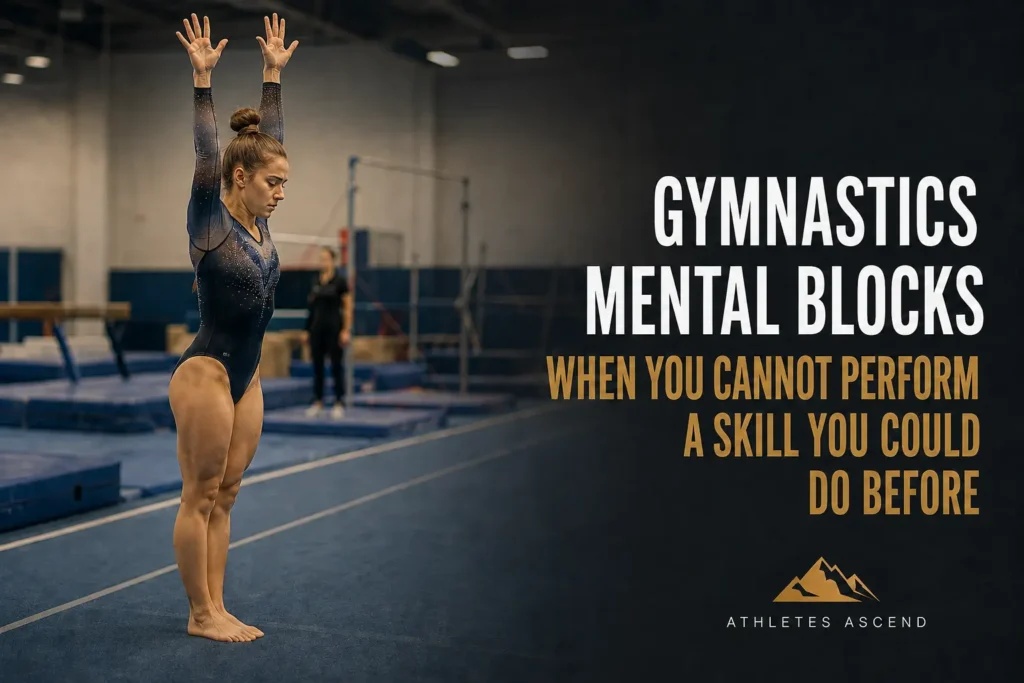
The gymnast may freeze, stop during the entry, need a spot or feel disconnected from an automatic movement. Blocks can affect floor, beam, bars, vault, trampoline or tumbling.
This is often called a mental block, psychological block or lost skill. Trampolining may use lost move syndrome.
The gymnast is not necessarily refusing to try. They may desperately want to perform while feeling their body will not follow their decision.
Call +44 07807 540142 or email me
Book Your Session
Ask a Question
What Does a Gymnastics Mental Block Feel Like?
Gymnasts describe different experiences, including:
- Freezing before initiating a skill.
- Running towards a movement but stopping.
- Losing a previously reliable backward skill.
- Performing with a spot but not independently.
- Completing the skill on one surface but not another.
- Feeling blank or unable to remember how the movement feels.
- Becoming frightened without knowing exactly why.
- Overthinking each part of an automatic action.
- Losing one skill before the block spreads to related movements.
Research defines lost move syndrome as being unable to perform a previously automatic skill. Studies with trampolinists connect it with increasing pressure, changes in how the movement is mentally represented and concern about appearing to others. Research on lost move syndrome
Why Can a Mental Block Develop?
There is no single explanation that applies to every gymnast.
Possible influences include:
- A fall, injury or frightening attempt.
- Fear of injury or reinjury.
- Learning or progressing a skill too quickly.
- Pressure surrounding competition or moving up a level.
- Changes in coach, gym or training environment.
- Growth spurts and changes in body awareness.
- Perfectionism in sport.
- Fear of disappointing coaches, parents or teammates.
- Fixating on a mistake and consciously controlling the movement.
- Stress outside gymnastics.
Sometimes there is no obvious trigger. Searching endlessly for one hidden cause may create more attention around the problem.
Is It the Same as the Twisties?
Not exactly.
“The twisties” generally describes a dangerous loss of spatial or aerial awareness during twisting skills. The gymnast may no longer feel certain where they are in the air or how they will land.
A gymnast experiencing this should not push through it. Safe technical rebuilding requires qualified coaches and suitable equipment. Cleveland Clinic describes returning to basics and safely reintroducing movements. Cleveland Clinic guidance
A broader block may occur before take-off, during the approach or only in one setting. The immediate safety implications may differ.
The Mental-Block Cycle
A movement feels frightening, the gymnast hesitates and every new attempt becomes a test. Attention, pressure and body tension increase. The gymnast consciously monitors the movement, and another hesitation appears to prove the skill has been lost.
This can damage sports confidence beyond the movement. The gymnast may question their courage, ability or future.
Why “Just Do It” Can Make Things Worse
From the outside, it can look as though the gymnast only needs to commit. Threats, punishment, bribery or remaining at the apparatus may instead add pressure.
Gymnastics Medicine’s guidance stresses that blocks are not simply a lack of motivation. It recommends patience, communication and returning to something achievable rather than repeatedly reinforcing the block.
Parents can provide support without making every journey home an investigation. Coaches remain responsible for safe progressions, spotting and decisions about attempts.
Rebuilding Without Constantly Testing the Skill
Practice can become unhelpful when every attempt asks the same question:
Have I got the skill back yet?
A qualified coach may rebuild the movement through appropriate progressions, safer surfaces, spotting and successful related skills.
Mindset support can stop those progressions becoming another examination. The focus shifts from proving the block has gone to creating safety, clarity and evidence.
This supports trust in training while respecting technical and physical realities.
How Sports Mindset Coaching May Help
Mindset coaching may help when anticipation, pressure and conscious interference maintain the block.
Work may include:
- Mapping where and when the block occurs.
- Identifying thoughts immediately before hesitation.
- Reducing shame and fear of failure.
- Separating an inability to initiate from unwillingness to try.
- Simplifying attentional cues.
- Reducing overthinking in sport.
- Preparing for being watched or returning to competition.
- Developing a constructive response after an unsuccessful attempt.
Inner Voice Awareness™ may help when technical instructions compete with criticism and fearful predictions.
Flow State Activation™ may support presence and more natural execution. Where appropriate, NLP and hypnotherapy for sports performance may form part of individual support.
These approaches do not replace qualified instruction, safeguarding, medical assessment, physiotherapy or mental-health treatment.
Coach’s Insight
The gymnast often asks:
Why can’t I just make myself do it?
A more useful question may be:
What would help my mind and body feel ready to access this movement safely again?
A mental block is a problem to understand, not a character judgement.
Frequently Asked Questions
Should a gymnast be forced to perform the skill?
No. Pressure can reinforce fear and unsafe execution. Decisions about progression should be made with appropriately qualified coaches.
How quickly can a lost skill return?
There is no universal timescale. The movement, history, safety considerations and maintaining factors differ.
Accessing the Movement Again
Losing a skill can be frightening. Progress means taking it seriously without making it the gymnast’s identity. Support can restore safe movement and trust.
The aim is not to force the body past fear. It is to create the conditions in which the gymnast can move safely and naturally again.
Gymnastics Mental-Block Coaching in Reading and Online
Matthew Exell provides sports mindset coaching in Reading, Berkshire, and online for gymnasts experiencing lost skills, freezing or fear around movements they could previously perform. Support may involve understanding when the block began, reducing the shame or frustration attached to it and helping the gymnast rebuild confidence through appropriate, progressive evidence. Mindset coaching does not replace technical supervision, safeguarding or decisions made by qualified gymnastics professionals. It is intended to support the psychological side of a carefully graded return, including attention, confidence and the response to setbacks. Where fear has spread beyond one movement, developing a more responsible understanding of fear of failure in sport may also be helpful.
Call +44 07807 540142 or email me