Elite performance isn’t only physical.
The way athletes think, interpret situations and respond to pressure has a significant influence on performance.
One approach that many coaches use to support psychological development is Neuro-Linguistic Programming (NLP).
NLP provides practical tools that can help athletes understand how their thoughts, emotions and behaviours interact. Rather than focusing only on what athletes do, NLP explores how they think, communicate with themselves and respond to challenges.
At Athletes Ascend, NLP forms one part of our wider approach to sports mindset coaching alongside performance psychology, coaching experience and practical performance strategies.
Call +44 07807 540142 or email me
Book Your Session
Ask a Question
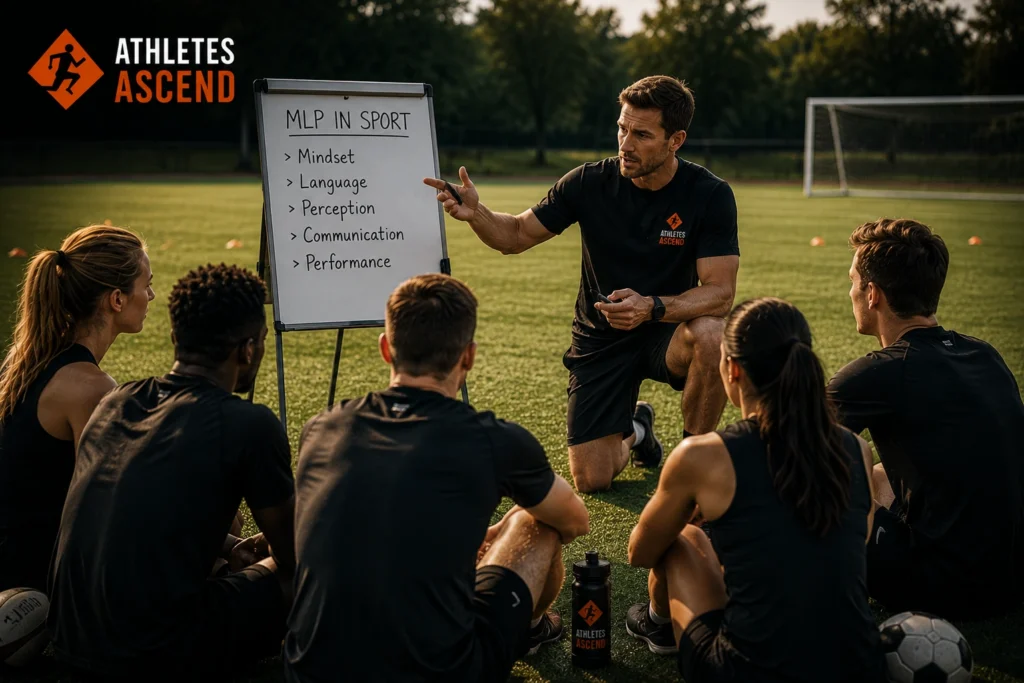
What Is NLP?
Neuro-Linguistic Programming, usually known as NLP, is a coaching and communication approach that explores how thoughts, language, emotions and behaviour influence performance.
Within coaching, NLP is often used to help athletes:
- Build confidence.
- Improve focus.
- Develop emotional control.
- Strengthen self-talk.
- Set meaningful goals.
- Reduce unhelpful thinking patterns.
- Perform more consistently under pressure.
Rather than changing who you are, NLP aims to help you make better use of the abilities you already possess.
How NLP Can Help Athletes
Every athlete experiences challenges.
Some struggle with confidence.
Others overthink.
Some lose focus during competition.
Others find it difficult to recover after mistakes.
NLP offers practical ways of understanding these patterns and developing more effective responses.
Areas where athletes often benefit include:
- Confidence.
- Performance anxiety.
- Competition nerves.
- Self-talk.
- Motivation.
- Emotional regulation.
- Goal setting.
- Mental preparation.
- Recovering after mistakes.
- Building resilience.
NLP and Performance
One of the strengths of NLP is its focus on performance rather than diagnosis.
Instead of asking:
“What’s wrong?”
NLP often asks:
“What works, and how can we do more of it?”
This practical approach encourages athletes to identify successful strategies and apply them more consistently during both training and competition. To understand which of the neurological levels you need help with.
Developing Better Mental Habits
Many of our thoughts and behaviours become automatic over time.
Some support performance.
Others quietly hold athletes back.
NLP helps athletes become more aware of these patterns and develop new ways of thinking and responding that better support their goals.
Small changes in thinking can lead to meaningful changes in behaviour.
Repeated behaviours become habits.
Habits influence long-term performance.
NLP Within the Athletes Ascend Approach
At Athletes Ascend, NLP isn’t used in isolation.
It works alongside ideas such as:
- Inner Voice Awareness.
- Flow State Activation.
- Identity.
- Self-Talk.
- Emotional Control.
- Confidence Building.
- Neurological Levels.
Together, these approaches help athletes better understand themselves while developing practical strategies that support consistent performance.
NLP Insight
Your mind already has patterns.
The question is whether those patterns are helping your performance or limiting it.
Coach’s Observation
Over the years, I’ve found that athletes often don’t need completely new abilities.
They need a better understanding of the abilities they already have and practical ways of using them more consistently under pressure.
That is one reason NLP can be such a valuable coaching tool.
A Balanced Perspective
NLP is widely used by many coaches, therapists and performance practitioners around the world.
Some athletes find its techniques extremely helpful.
Research into NLP has produced mixed results, and not every claim associated with NLP is supported by strong scientific evidence.
For that reason, at Athletes Ascend we use NLP as one practical coaching framework alongside evidence-informed sports psychology, performance coaching and individual experience rather than treating it as a standalone solution.
You will find that with an understanding of your inner voice will enable flow state.
Frequently Asked Questions
What does NLP stand for?
NLP stands for Neuro-Linguistic Programming, a coaching approach that explores how thoughts, language, emotions and behaviour influence performance.
Is NLP used in sport?
Yes. Many coaches and performance practitioners use NLP techniques to help athletes improve confidence, focus, emotional regulation, goal setting and mental preparation.
Is NLP scientifically proven?
Some NLP techniques have supportive evidence, while broader research on NLP has produced mixed findings. It is generally best viewed as one coaching framework rather than a complete scientific theory.
Can NLP improve sports performance?
NLP may help athletes develop more effective mental habits, improve self-awareness and strengthen confidence and emotional control when integrated with other coaching approaches.
Is NLP suitable for all athletes?
Many athletes find NLP techniques useful, particularly when they are adapted to the individual’s sport, personality and goals.
How I Work With Athletes
I combine practical sports mindset coaching with NLP, hypnotherapy where appropriate, and performance-psychology principles. The approach depends on the athlete, the sport and what is maintaining the problem. It complements technical coaching, medical care and rehabilitation rather than replacing them.
Unlock the Potential You Already Have
Outstanding performance isn’t only about developing new skills.
It’s also about making better use of the strengths you already possess.
At Athletes Ascend, we combine NLP with practical coaching, performance psychology and proven mindset strategies to help athletes build confidence, perform consistently and reach their potential.
Call +44 07807 540142 or email me