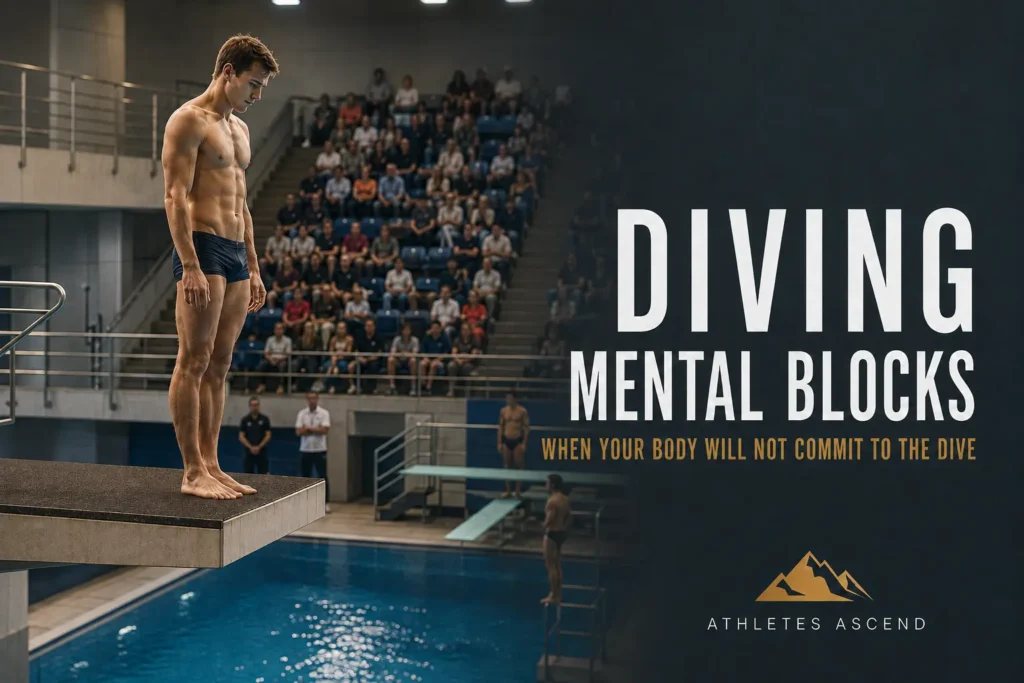
A diver can know exactly what to do and still find themselves unable to leave the board.
They may have completed the dive many times before. Then, after a frightening entry, collision, injury, growth spurt or unexplained loss of confidence, the approach changes. They stop, balk, hesitate or alter the movement at the last moment.
The diver has not necessarily forgotten the skill. Their protective system has started treating it as a threat.
What Does a Diving Mental Block Look Like?
A diver may experience:
- Stopping during the hurdle or approach.
- Repeatedly walking to the end without diving.
- Losing one dive while others remain available.
- Freezing on reverse or inward dives.
- Being able to use a harness but not dive independently.
- Opening early or changing the skill in the air.
- Feeling disorientated during twisting movements.
- Completing lead-ups but avoiding the full dive.
- Becoming frightened after hitting the board or water badly.
Online searches often sound more emotional than technical: “Why am I suddenly scared to dive?”, “I know I can do the dive but my body won’t let me”, “how do I stop balking in diving?”, “I lost my reverse dive” and “how to get over a diving mental block”.
These phrases describe a conflict between intention and protection. The diver wants to go, but another response applies the brakes.
Is It Psychological, Technical or Physical?
Not every refusal is a mental block.
Timing, board work, take-off, rotation, spotting and entry require assessment by a qualified diving coach. Growth, fatigue, pain, concussion, injury or spatial changes may affect a secure movement. Dizziness, unusual disorientation or persistent physical difficulty require medical assessment.
Fear can also contain accurate information. If the dive is not technically ready, removing caution would be unsafe. Mindset work should never persuade a diver to override reasonable protection.
However, when the progression is appropriate and the technique has been assessed, repeated conscious supervision can become overthinking in sport. The diver monitors the board, arms, take-off, rotation and entry until a coordinated action becomes several anxious decisions.
How a Dive Becomes Blocked
The cycle may develop like this:
- A dive produces a painful, frightening or disorientating experience.
- The diver anticipates that moment during the next attempt.
- Breathing, muscle tension and attention change.
- The approach becomes cautious or over-controlled.
- The diver stops, alters the dive or performs it poorly.
- The result appears to prove that the dive is unsafe.
Sometimes there is no obvious incident. Competition pressure, criticism, perfectionism or several inconsistent attempts can gradually weaken sports confidence.
The block then becomes embarrassing as well as frightening. The diver worries about wasting training time, disappointing the coach or being watched by teammates. This adds fear of failure to the original fear of injury.
What Diving Research Found
A qualitative study of former elite springboard and highboard divers examined the barriers and facilitators involved in overcoming mental blocks.
The researchers identified four barriers: emotions, loss of control, poor coaching and physical sensations. Facilitators were preparatory skills, teammates, good coaching and cognitive skills.
The divers referred to lead-ups, physical preparation, encouragement, emotional support, healthy competition, modelling, self-talk and visualisation. This is valuable because it shows that recovery is not simply a matter of “being brave.” Confidence is influenced by the progression, environment, relationships and the diver’s interpretation of what is happening.
It also supports self-efficacy: belief grows from credible experiences of capability, not repeated instructions to think positively.
Tom Daley and Losing Orientation
Tom Daley has spoken about experiencing the diving equivalent of the “twisties” after the London 2012 Olympics. He described becoming lost in the air and not knowing which way was up or down.
That distinction is crucial. Aerial disorientation is not ordinary nervousness, and forcing a diver through it can create serious danger. Daley later praised Simone Biles for withdrawing from Olympic gymnastics events when she experienced the twisties, recognising that continuing could have caused injury.
Daley has also discussed visualisation as part of his preparation and has spoken openly about anxiety, grief, pressure and learning not to base his entire self-worth on diving. His experience shows that elite achievement does not create immunity from psychological difficulty.
US Olympic medallist Steele Johnson has also discussed mental blocks as a normal issue within diving. Normal does not mean trivial; it means the diver is not uniquely weak or broken.
Rebuilding the Dive Safely
The diving coach should control the technical progression. Depending on the athlete and skill, this might involve dryland work, trampoline, spotting, harness work, simpler movements, lead-ups, lower boards or returning to a trusted stage of the dive.
The objective is not to test the full dive until fear disappears. Every failed test can strengthen the belief that something is wrong. A better progression creates manageable evidence while preserving choice and communication.
Helpful principles may include:
- Agreeing what the diver will attempt before reaching the board.
- Using a difficulty that produces challenge without panic.
- Keeping practice blocks purposeful rather than exhausting.
- Recording progress beyond successful full dives.
- Allowing a step backwards without treating it as failure.
- Gradually reintroducing observation and competition pressure.
This is how rebuilding confidence in sport becomes evidence-based rather than dependent on reassurance.
Attention, Self-Talk and Mental Rehearsal
A blocked diver may approach with several commands:
Do not stop. Do not hit the board. Jump up. Stay tight. Find the water.
That is too much for the final seconds.
A coach may select one useful cue connected to rhythm, direction or intention. Better focus in sport is selective, not the ability to monitor everything.
Mental rehearsal can include the approach, take-off, movement and safe entry, but it should not become another compulsory test. Divers with aphantasia can rehearse timing, sound, bodily sensation and verbal sequence without visual pictures.
Developing Inner Voice Awareness™ may help when the diver’s final message is simultaneously “go” and “this is dangerous.”
Can NLP or Hypnotherapy Help?
NLP or hypnotherapy may help explore an automatic fear response, the emotional meaning of an incident, anticipatory imagery and unhelpful internal language. They may support calmer rehearsal and a more proportionate response to a technically appropriate progression.
I found examples of hypnosis and self-hypnosis in freediving, but no reliable named springboard or platform diver who publicly attributed recovery from a mental block to NLP or hypnosis. It would therefore be misleading to claim otherwise.
These approaches must complement qualified diving coaching and medical care. They should never be used to suppress valid warning signals or promise that a diver will complete a particular skill. See NLP and hypnotherapy for sports performance for further explanation.
How Sports Mindset Coaching May Help
Mindset work may include:
- Identifying the precise point where commitment changes.
- Separating genuine technical danger from learned anticipation.
- Changing the response to a balk or poor entry.
- Reducing shame and pressure around the block.
- Developing simple cues and flexible routines.
- Preparing for being watched or judged.
- Supporting emotional control without demanding total calm.
- Helping the diver trust their training again.
The aim is not fearlessness. A diver can feel uncertainty and still make an appropriate, fully supported attempt.
Coach’s Insight
The blocked diver often asks:
How do I force myself to do it?
A more useful question may be:
What conditions would allow my body to recognise that this step is ready and safe enough to attempt?
That moves the problem from courage versus weakness towards preparation, trust and communication.
Frequently Asked Questions
Why have I suddenly lost a dive I could already do?
A frightening attempt, pressure, growth, fatigue, technical change or conscious interference may contribute. Your coach should assess the whole situation.
Should I keep attempting the full dive?
Not automatically. Repeated overwhelming attempts may strengthen the block. The progression belongs with a qualified diving coach.
Does balking mean I am not committed enough?
No. Balking may be a protective response. Shame or punishment can intensify it.
Can mindset coaching guarantee the dive will return?
No. It may help with fear, attention and anticipation, but technical, physical and safety factors remain essential.
Trusting the Board Again
A diving mental block can make a capable athlete feel betrayed by their own body.
Recovery begins by taking the response seriously, checking technical and physical safety, and creating a progression that restores evidence rather than demands courage on command.
The goal is not to force the diver from the board. It is to rebuild the conditions in which preparation can become commitment again.