A shooter can perform consistently in training and feel completely different once every shot counts.
The hold becomes less settled. The trigger feels unusually significant. A clay shooter starts protecting against another miss, while a rifle or pistol competitor waits for a sight picture that never feels perfect enough.
The technical skill has not suddenly disappeared. Competition has changed attention, muscle tension, timing and the meaning attached to the shot.
Shooting performance psychology helps competitors manage those changes. It is not about becoming emotionless. It is about remaining clear enough to follow a trained process while nerves, expectation and uncertainty are present.
Call +44 07807 540142 or email me
Book Your Session
Ask a Question
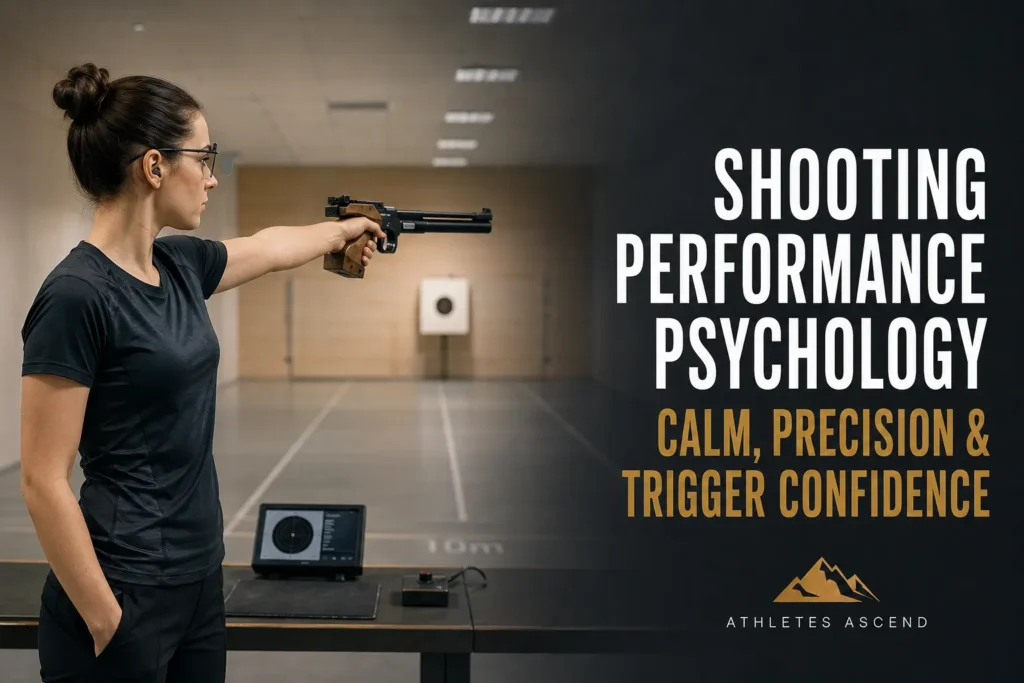
Shooting Is Not One Psychological Challenge
Shooting sports include air rifle, small-bore rifle, air pistol, sport pistol, rapid-fire events, trap, skeet, sporting clays and Para shooting, among other disciplines. Each has different technical and competitive demands.
In precision rifle and pistol events, the athlete performs a largely self-paced action and may have time to think before every shot. This can create over-holding, trigger hesitation and excessive searching for perfection.
Shotgun and clay disciplines require a responsive action towards a moving target. After a miss, the shooter may become protective, alter timing or start trying to guarantee contact rather than responding naturally.
Across disciplines, competitors ask why they shoot better in practice, how to manage shaking, why they hesitate at the trigger, how to recover after consecutive misses and how to trust a routine when they do not feel calm.
These are performance questions. Any concern involving safety, equipment or shooting technique must be addressed by an appropriately qualified shooting instructor within the rules and safety procedures of the relevant discipline.
Calm Does Not Mean Completely Still
Shooters may believe they must eliminate every tremor, thought or sensation before beginning. This turns calmness into another test. The psychological skill is not creating perfect stillness; it is preventing normal movement from becoming a threat.
A shooter who thinks, “I must stop shaking,” often monitors the shake more closely. Tension increases and the hold may become less natural. This connects with performance anxiety in sport and the effort to control every internal sensation.
Calm is better understood as workable readiness: enough stability to follow the process without needing the body to feel exactly right.
Trigger Confidence and the Search for the Perfect Moment
Trigger confidence involves trusting the action rather than forcing or avoiding it.
Under pressure, a shooter may hold too long, repeatedly abandon the attempt or rush before losing an acceptable sight picture. In shotgun disciplines, anticipation may appear as flinching, hesitation or altered timing.
Research involving female sport-pistol competitors found that greater pre-competition anxiety was associated with impaired performance and increased trigger time. This does not mean every hesitation is psychological, but it supports the connection between arousal, confidence and timing.
The answer is not simply “pull the trigger”. A qualified technical coach should assess the action, physical set-up and equipment. Mindset work can then address the fear, prediction and conscious interference surrounding it.
This is closely related to overthinking in sport: the athlete knows the process but begins supervising every part of it once the result matters.
The Role of a Pre-Shot Routine
A pre-shot routine can organise attention and create a dependable transition from preparation into execution.
The precise routine belongs with the shooter and technical coach; psychologically, it answers three questions:
- What am I attending to?
- What am I committing to?
- How will I recognise when I should reset rather than force the attempt?
A study of elite 10-metre air-pistol shooters reported improved competition scores after individualised pre-shot routines were developed and practised. The value came from consistent preparation, not a rigid ritual.
The routine becomes unhelpful if the shooter believes every element must feel perfect. It should support concentration in sport, not become another form of checking.
What Elite Shooters’ Experiences Teach Us
Olympic champion Abhinav Bindra has spoken about anxiety and a near-sleepless night before winning 10-metre air-rifle gold at Beijing 2008. He performed while anxiety was present.
Before Paris 2024, Bindra advised shooters to prepare for an imperfect day. His point was not to expect poor performance. It was to avoid making success dependent on waking up with the ideal feeling, conditions or confidence.
American rifle shooter Lanny Bassham won Olympic silver in 1972 and gold in 1976. Between those Games, he investigated how successful performers managed the mental side of competition and developed a structured approach to mental preparation. His USA Shooting Hall of Fame profile records both his Olympic achievements and later work as a coach and author.
Para pistol shooter Marco De La Rosa has described missing an earlier qualification opportunity after putting excessive pressure on himself and “forcing” shots. Before qualifying for Paris 2024, he focused on following the same process for each attempt. His story illustrates an important distinction: precision usually comes from returning to a process, not demanding an outcome.
Their approaches differed, but each acknowledged pressure and prepared deliberately rather than waiting for confidence to appear.
Recovering After a Poor Shot or Missed Target
One result can quickly become a prediction:
That has gone. Do not do it again.
The shooter may then rush to repair the score, become overly cautious or make an emergency technical change.
Learning to recover after mistakes involves separating useful information from emotional judgement. A reset may include acknowledging the result, identifying whether any genuine adjustment is required and returning to the agreed process.
After consecutive misses or near the end of a match, the next shot does not need the previous one to have been good. It needs the shooter to be available again.
Confidence Built From Evidence
Fragile confidence says:
I feel good, so I should shoot well.
More stable sports confidence says:
I have prepared for different conditions, and I know what to return to.
Confidence can be built from process evidence as well as scores: following the routine under pressure, resetting after a miss and staying committed when timing feels imperfect.
This supports consistency in sport because the athlete is repeating useful behaviours rather than expecting identical outcomes.
How Sports Mindset Coaching May Help
Mindset coaching may help a shooter understand the training-to-competition gap, manage nerves, develop a flexible routine, reduce hesitation linked with fear or perfectionism, refocus after a miss and prepare for finals or selection. It can also build confidence from controllable evidence rather than one result.
Inner Voice Awareness™ may help when the athlete’s final moments contain several conflicting instructions: “hold still”, “do not snatch it”, “this one matters” and “you cannot miss again”.
Mindset coaching should complement qualified technical coaching and formal range safety. Pain, visual changes or involuntary movement may require healthcare assessment.
Coach’s Insight
The shooter often asks:
How can I make sure this shot is perfect?
A more useful question may be:
What allows me to commit to a sound process without demanding a perfect feeling first?
Precision is not created by desperation for control. It is supported by preparation, selective attention and the confidence to let the trained action happen.
Frequently Asked Questions
Why do I shake more during competition?
Competition can increase arousal, self-awareness and muscle tension. The aim is not necessarily to remove every sensation, but to keep it within a range where you can follow your process.
What is trigger hesitation?
It describes difficulty committing to or completing the trigger action. Possible influences include technique, equipment, fear of a poor shot, perfectionism and performance pressure, so proper assessment matters.
Is trigger hesitation the shooting equivalent of the yips?
It can resemble a performance block, but the terms should not be used as an automatic diagnosis. Persistent involuntary movement or symptoms outside competition may require medical assessment.
Can a pre-shot routine reduce nerves?
It may organise attention and create familiarity, but it should not be used as a ritual that guarantees calm or a particular score.
How do I recover after missing an easy target?
Acknowledge the miss without turning it into an identity statement, retain any useful information and return deliberately to the next process.
Performing With the Pressure Present
Competitive shooting magnifies small changes in attention, tension and timing, which is why manufacturing perfect calm can become counterproductive.
The stronger objective is to recognise pressure, remain connected to the current process and keep trusting your training when the outcome cannot be guaranteed.
The best shot does not always begin with the perfect feeling. Sometimes it begins with the decision that the feeling does not have to be perfect.
Shooting Performance Coaching in Reading and Online
Matthew Exell provides sports mindset coaching in Reading, Berkshire, and online for competitors across rifle, pistol and shotgun disciplines. Sessions may focus on competition nerves, perfectionism, concentration, trigger hesitation or the loss of trust that can appear when every part of the shot is consciously monitored. This work addresses the psychological side of performance rather than firearm technique. Safety, equipment and discipline-specific instruction must remain with appropriately qualified shooting professionals. Mindset coaching can help a competitor develop a more useful pre-shot focus and respond constructively after an unexpected miss without demanding perfect calm. This may also connect with learning to manage choking under pressure while retaining proper safety and judgement.
Call +44 07807 540142 or email me