You know the rope is there.
You trust your belayer and understand the equipment. Yet once you move above the last bolt—or reach the point where falling becomes possible—everything changes.
Your forearms tighten. You overgrip holds that should feel manageable. You stop breathing naturally, repeatedly check the protection or climb down despite having the physical ability to continue.
Fear of falling is normal in climbing. It is part of a system designed to protect you from danger.
The difficulty begins when fear is stronger than the present situation requires and prevents climbing in appropriately assessed conditions.
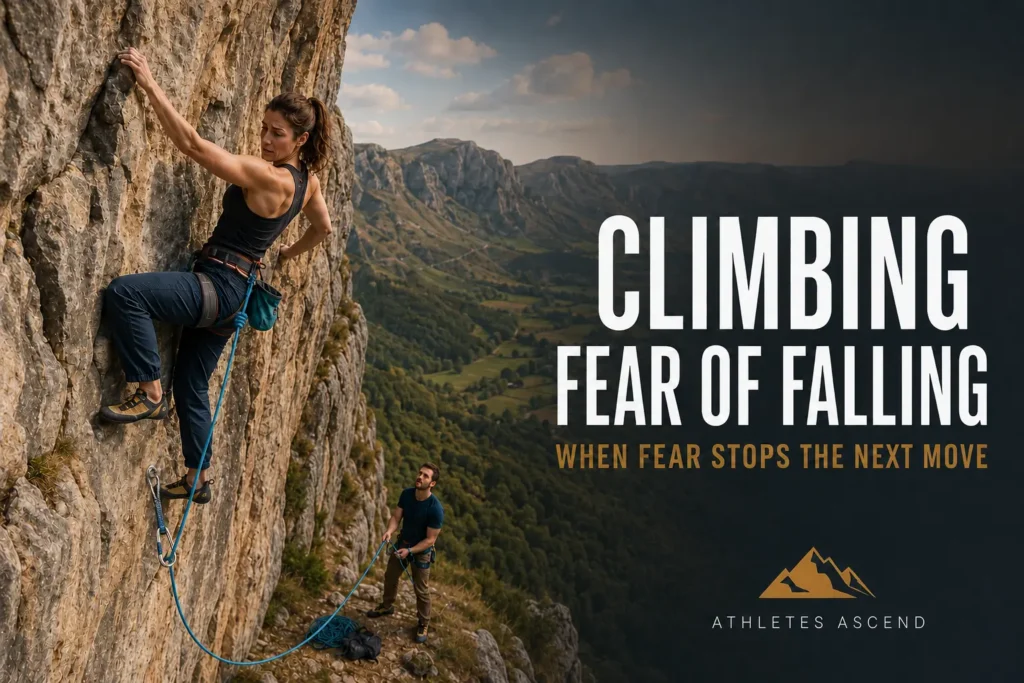
What Does Fear of Falling Look Like in Climbers?
Fear does not always look like obvious panic. A climber may experience:
- Freezing above a bolt or piece of protection.
- Refusing to move unless the rope is tight.
- Climbing confidently on top rope but struggling when leading.
- Overgripping and becoming exhausted unnecessarily.
- Avoiding routes where a fall is possible.
- Downclimbing rather than committing to a move.
- Climbing well indoors but becoming frightened outside.
- Losing confidence after a frightening or unexpected fall.
The climber may call this “fear of falling”, “lead climbing anxiety”, “freezing on the wall” or simply “getting gripped”. These phrases describe related experiences, but not
Fear of Falling, Fear of Heights or Fear of Failure?
It helps to identify what the fear is actually responding to.
Some climbers fear the sensation of falling. Others fear injury, equipment failure, an inattentive belayer or striking a ledge. A climber may tolerate height while securely supported but fear losing contact with the wall.
The concern may also be social:
What if everyone sees me fail on an easy route?
That connects the problem with fear of failure in sport and judgement. The climber is not only avoiding a fall; they are protecting an identity.
Concern about unsuitable protection, poor belaying, dangerous fall zones or climbing beyond your ability should never be dismissed as a psychological block.
The Fear-and-Tension Cycle
Fear can change the way you climb:
- You anticipate a possible fall.
- Attention narrows towards the rope, bolt or distance below you.
- Breathing becomes restricted and grip pressure increases.
- Movement becomes stiff and inefficient.
- Fatigue develops more quickly.
- The route now feels less controllable.
- That experience appears to prove that your fear was justified.
This resembles performance anxiety in sport. The protective response creates physical changes that make confident climbing more difficult.
The climber may then compensate by analysing every hand position, foothold and possible outcome. This can become overthinking in sport rather than useful route reading.
What Experienced Climbers and Mental Coaches Have Learned
Elite British climber Hazel Findlay has spoken openly about fear and now coaches climbers through her Strong Mind work. She identifies falling, injury, exposure, failure and performance anxiety as common concerns.
Her approach involves understanding the response and progressively engaging with situations the climber has learned to avoid. Findlay explains the foundations of this work in her Strong Mind climbing FAQ.
Climbing psychologist Allegra Maguire emphasises gradual practice, breathing, relaxation and familiar routes. This reduces technical demands while the climber learns to respond differently to falling.
Arno Ilgner, author of The Rock Warrior’s Way, developed an approach centred on attention, risk assessment and commitment. It treats falling as a skill to be learned under suitable supervision.
Although their terminology differs, the shared principle is clear:
Confidence comes from informed experience, not from pretending the risk does not exist.
Rebuilding Confidence Without Forcing the Fall
Avoidance brings immediate relief. If you ask for a tight rope or climb down, anxiety reduces. The mind may then learn:
I was safe because I avoided falling.
However, forcing yourself into a large fall before you are prepared can intensify the fear. The aim is not to prove bravery by becoming overwhelmed.
A qualified instructor may design a progression using controlled conditions, suitable routes, correct equipment and a competent belayer. Practical decisions belong with the climbing professional.
A useful progression creates new evidence without overwhelming the climber. This is how sports confidence becomes based on experience rather than reassurance.
Trusting the Belayer and the System
Sometimes the primary difficulty is not falling; it is trust.
A previous hard catch, excessive slack, poor communication or unexpected fall may have changed how safe the system feels. Repeating “the rope will hold” may not address what happened.
Confidence may require clearer communication, a trusted partner, understanding different catches, recognising suitable fall zones and rebuilding difficulty progressively.
Learning to trust your training includes trusting preparation, equipment and teamwork—but only when each has been properly established.
Where Should Attention Go?
A frightened climber may divide attention between the next hold, the last bolt, the rope, the belayer and everything that might go wrong.
Effective focus in sport is selective. Once safety decisions have been made, attention may need to return to the task immediately available: breathing, feet, balance, rhythm or the next movement.
This means assessing risk and then climbing rather than repeatedly reopening the same decision.
Mindfulness in sport may also help a climber notice fear without automatically obeying it. You can recognise “I feel frightened” without immediately concluding “I must retreat”. You can also decide that the situation is genuinely unsuitable and come down.
Flexible judgement matters more than forced commitment.
Changing the Inner Warning Voice
The internal commentary may become relentless:
You are too far above the bolt.
You will slip.
Do not move your hand.
Trying to overpower this with “I’m completely safe” may create another argument. More useful self-talk in sport is specific and believable:
Check complete. Return to the next move.
Breathe, soften the grip and use my feet.
I can commit—or make a clear decision to come down.
Developing Inner Voice Awareness™ can help identify whether your mind is providing relevant information or replaying a warning after the situation has already been assessed.
Can Hypnotherapy or NLP Help Fear of Falling?
Some climbers explore hypnotherapy or NLP because the response feels automatic. They know the protection is sound, yet their body reacts as though a fall is already happening.
Where appropriate, these methods may explore learned associations, previous frightening experiences, anticipatory imagery, internal language and emotional responses.
They do not replace climbing experience, fall technique, equipment knowledge or qualified instruction. No practitioner should promise to remove sensible fear.
My wider approach to NLP and hypnotherapy for sports performance explains how these methods may sit alongside practical mindset coaching.
How Sports Mindset Coaching May Help
Mindset coaching may help you:
- Identify the precise moment fear changes your climbing.
- Separate realistic risk from repeated anticipation.
- Understand the effect of fear on breathing, grip and movement.
- Develop useful attentional cues.
- Respond differently to memories of a previous fall.
- Reduce embarrassment and fear of being judged.
- Build a progressive psychological plan with your climbing coach.
- Develop greater emotional control in sport.
This complements climbing instruction. Severe panic, persistent flashbacks or distress following an accident may require an appropriately qualified mental-health professional.
Coach’s Insight
The climber often asks:
How do I stop being afraid of falling?
A more useful question may be:
How can I assess the risk properly and remain able to act while fear is present?
Climbing confidence is not the absence of fear. It is the ability to use information, skills and judgement without an old alarm controlling every move.
Frequently Asked Questions
Is fear of falling normal in climbing?
Yes. Falling can involve genuine risk. The objective is not to eliminate fear but to make it proportionate and useful.
Should I practise taking falls?
Fall practice may help, but it must be planned and supervised by a suitably qualified climbing professional who can assess the route, equipment, belayer and fall zone.
Can mindset coaching guarantee that I will feel calm?
No. Climbing contains uncertainty. Coaching may help you understand fear and respond more effectively without promising complete calmness.
Climbing With Fear Rather Than Against It
Fear does not mean you are weak or incapable. It may contain useful safety information, an old lesson from a previous experience or a prediction that has become stronger than the present situation requires.
Progress begins by respecting genuine risk, working with qualified climbing professionals and understanding what happens in the moment your confidence changes.
You do not need to become fearless.
You need enough trust, attention and flexibility to make a sound decision—and then climb the move in front of you.