You know how to throw a dart.
You may have played successfully for years, practised thousands of throws and developed an action that once felt completely natural. Yet when you raise your arm to throw, something changes.
The dart feels stuck in your hand. Your fingers will not release it at the expected moment. Your arm may freeze, hesitate or make several unsuccessful attempts to begin the throw. Occasionally, the dart leaves unexpectedly or the movement feels forced.
This is commonly known as dartitis.
The thing is, dartitis does not necessarily mean you have forgotten how to play. Nor does it automatically mean you lack confidence or cannot cope with pressure. The problem may involve psychology, learned anticipation, excessive conscious control, technical factors or, in some cases, a task-specific movement disorder.
Understanding what happens in your particular throwing action matters more than applying one universal solution.
Call +44 07807 540142 or email me
Book Your Session
Ask a Question
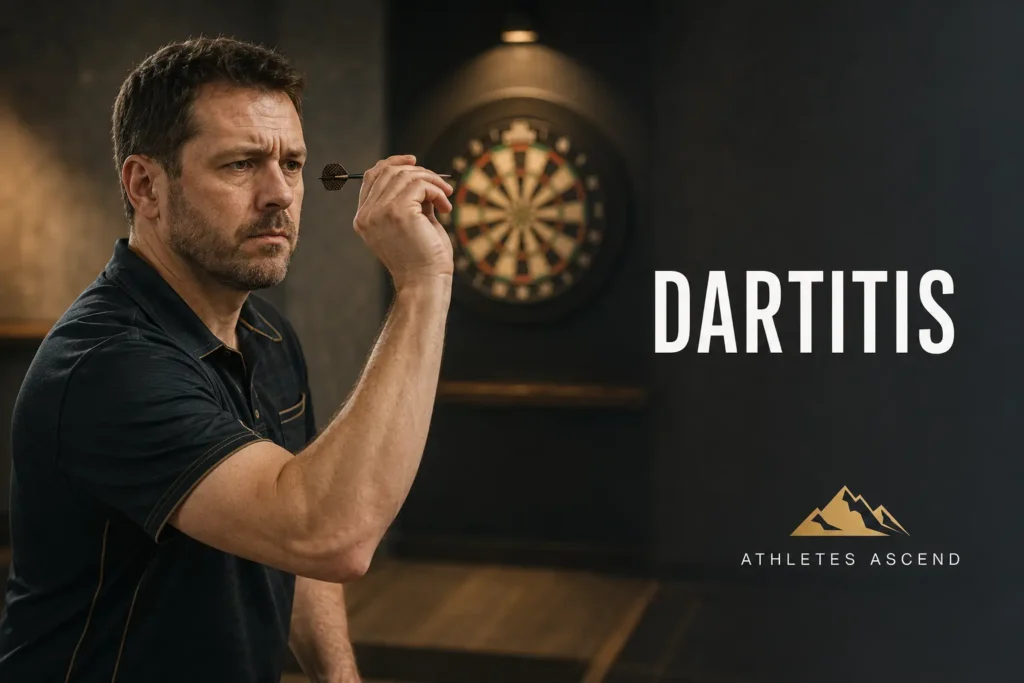
What Is Dartitis?
Dartitis is a disruption of the normally automatic throwing action. It most commonly affects the preparation, forward movement or release of the dart.
Players describe experiences such as:
- Being unable to let go of the dart.
- Freezing at the top of the throwing action.
- Repeatedly starting and stopping.
- Pulling the arm backwards several times.
- Gripping the dart more tightly.
- Releasing much earlier or later than intended.
- Feeling that the hand will not obey the decision to throw.
- Throwing relatively freely in practice but struggling during matches.
- Becoming preoccupied with whether the next dart will leave the hand.
Some players experience dartitis in every situation. Others notice it only during competition, against particular opponents, on doubles or when the outcome feels especially important.
That specificity provides useful information.
Dartitis can sit within the wider mental challenges explored through darts performance psychology, although it deserves its own page because of the specific disruption to the throwing action.
Is Dartitis Psychological or Neurological?
There is no single explanation that applies to every player.
The wider yips literature suggests that disrupted sporting movements can exist on a continuum. At one end, anxiety, anticipation and excessive conscious control may interfere with an otherwise functional movement. At the other, involuntary contractions, tremors or spasms may involve task-specific focal dystonia or another movement disorder.
These possibilities can also overlap.
Pressure may intensify an existing movement problem. Equally, one uncomfortable release may cause a player to watch, control and protect the action so closely that a temporary disruption becomes a learned pattern.
Dartitis should therefore not be dismissed as “all in your head.” However, it should not automatically be diagnosed as dystonia without an appropriate medical assessment either.
If you experience persistent tremors, spasms, pain or involuntary movement—particularly outside darts—consult a doctor, neurologist or suitably qualified movement-disorder specialist.
How an Automatic Throw Becomes Consciously Controlled
A developed darts action contains many small movements: stance, visual alignment, grip pressure, preparation, elbow position, acceleration and release.
When the action works naturally, the player does not need to issue a conscious instruction for every component.
After one difficult release, however, attention may turn inward:
- Are my fingers going to open?
- Is my arm moving correctly?
- What if it sticks again?
- When exactly should I release?
- Why can’t I make myself throw?
The player begins trying to supervise an automatic action consciously. This is closely connected with overthinking in sport.
The harder they attempt to guarantee the release, the less natural it feels.
The Dartitis Cycle
Dartitis often develops into a repeating cycle:
- A throw sticks, jerks or feels uncomfortable.
- The player becomes concerned about it happening again.
- Attention shifts towards the mechanics of releasing.
- Grip pressure and muscle tension increase.
- The throw becomes slower or more deliberate.
- The dart becomes harder to release naturally.
- The next difficulty appears to confirm that the action is broken.
This can produce understandable self-doubt in sport. The player may still throw freely occasionally, but every successful dart is followed by the question: “Will I be able to do it again?”
Why Forcing the Release Can Strengthen the Problem
A natural response is to try harder.
The player may count down, snatch the dart forward, repeatedly rehearse the release or force their fingers to open. These strategies can occasionally produce a throw, but they may also teach the mind that releasing is a threatening event requiring exceptional effort.
More effort is not always the same as more control.
Forcing the movement may increase tension and reinforce the expectation that the dart will stick. The goal is not simply to overpower the problem. It is to understand what is maintaining it and gradually restore a safer, more reliable relationship with the throwing action.
Separating Throwing From Scoring
Every practice throw normally ends with an immediate judgement: where did the dart land?
When dartitis develops, this result-focus can increase pressure on the release. A useful technical coach may temporarily simplify practice so success is measured by completing a comfortable process rather than hitting a particular number.
Depending on the player, practice might progress from:
- Holding and lowering the dart without throwing.
- Rehearsing the movement without a target.
- Throwing towards a large, non-scoring area.
- Using shorter or less formal practice periods.
- Gradually returning to numbered targets.
- Reintroducing doubles, scoring and match situations progressively.
This is not a universal prescription. A qualified darts coach should help ensure that technical changes are appropriate rather than allowing anxiety-driven experimentation to create additional complications.
Confidence Must Be Built From Relevant Evidence
Generic reassurance rarely resolves dartitis.
Being told “you can do it” may be well-intentioned, but confidence usually returns through credible experiences of completing the action with less interference.
This is why rebuilding confidence in sport involves evidence rather than forced positive thinking.
The evidence may initially be modest:
- One comfortable release.
- A short sequence without forcing.
- Recognising tension before it controls the action.
- Lowering the dart calmly instead of fighting the throw.
- Completing a practice task without judging the score.
- Recovering after one difficult release.
Progress does not require every dart to feel perfect.
Pressure, Embarrassment and Fear of Judgement
Dartitis is highly visible. The player may feel that their opponent, teammates and spectators are waiting while they struggle to throw.
This can create performance anxiety in sport and fear of embarrassment. The player is no longer merely throwing a dart; they are also trying to conceal the problem.
That additional task increases mental and physical load.
Some players avoid leagues, competitions or practice partners. Others rush the action to prevent anyone noticing. Avoidance may bring temporary relief while making the eventual return feel more threatening.
A progressive return should therefore include both the movement and the social setting in which it occurs.
How Sports Mindset Coaching May Help
Sports mindset coaching cannot diagnose or medically treat dystonia. It can help when anticipation, attention, pressure, fear or learned responses are interfering with performance.
Work may include:
- Mapping exactly where the action changes.
- Identifying the thoughts and sensations preceding the freeze.
- Reducing threat attached to an imperfect release.
- Shifting attention away from excessive mechanical monitoring.
- Developing a calmer pre-throw routine.
- Rebuilding confidence through progressive evidence.
- Preparing for competition and being watched.
- Responding differently after a difficult dart.
This connects with developing greater Inner Voice Awareness™ and recognising the instructions, predictions and warnings occurring before the throw.
The objective is not to stop every thought. It is to prevent thoughts from taking unnecessary control of a trained movement.
Technical, Psychological and Medical Support
Dartitis can cross professional boundaries.
A darts coach can assess grip, stance, timing and throwing mechanics. A sports mindset coach can work with pressure, attention and learned anticipation. A medical professional can assess persistent involuntary movement.
The most responsible approach may involve more than one form of support.
It is particularly important not to practise through pain or assume that every physical symptom is psychological.
Coach’s Insight
The most useful question is often not:
How do I force myself to release the dart?
It is:
What happens in the final moments before the release becomes difficult?
That change of question moves attention from fighting the symptom towards understanding the pattern.
Frequently Asked Questions
Can dartitis happen suddenly?
Yes. It may appear after one significant incident or emerge gradually through increasing hesitation and conscious control.
Is dartitis the same as choking?
Not necessarily. Choking under pressure is one possible influence, but dartitis can also occur in practice and may include neurological or technical factors.
Should I change my grip or throwing hand?
Some players experiment with technical changes, but this should ideally be discussed with an experienced darts coach. Constantly changing technique can sometimes increase uncertainty.
Can I practise my way through it?
Unstructured repetition may reinforce the difficulty if every throw involves tension and fear. Carefully designed, progressive practice is normally more useful.
Does dartitis mean my career is over?
No. Players respond differently, and improvement is possible. However, no coach should guarantee a cure or a particular timescale.
Can mindset coaching help?
It may help when pressure, anticipation, fear of judgement or conscious interference are maintaining the problem. Persistent involuntary movement should also receive appropriate medical consideration.
How I Work With Athletes
I combine practical sports mindset coaching with NLP, hypnotherapy where appropriate, and performance-psychology principles. The approach depends on the athlete, the sport and what is maintaining the problem. It complements technical coaching, medical care and rehabilitation rather than replacing them.
Rebuilding a Freer Throw
Dartitis can be frightening because it interferes with something that once happened without thought.
But the presence of interference does not prove that your ability has disappeared.
The work is to understand whether the main barrier is technical, psychological, neurological or overlapping—and then build the right support around it.
Explore the wider relationship between focus and athletic performance, trusting your training and recovering after mistakes in competition.
If you would like help understanding the psychological pattern surrounding your throw, you can book a session or ask a question.
Call +44 07807 540142 or email me